Wireless charger supplier audit: what to check on a visit
An audit is not a tour. The useful part of a supplier visit is the evidence you can carry out of the building, and most of it sits in five places that are easy to walk past.
The visit has an order
A charger programme is small enough to see in a day. The goods come in, a line places the coil and the board, a fixture tests the assembly, a rack runs it, and a file is packed with the carton. Five stops, and each one explains the one before it: a fixture that passes everything looks different once you have seen what arrives at the door.
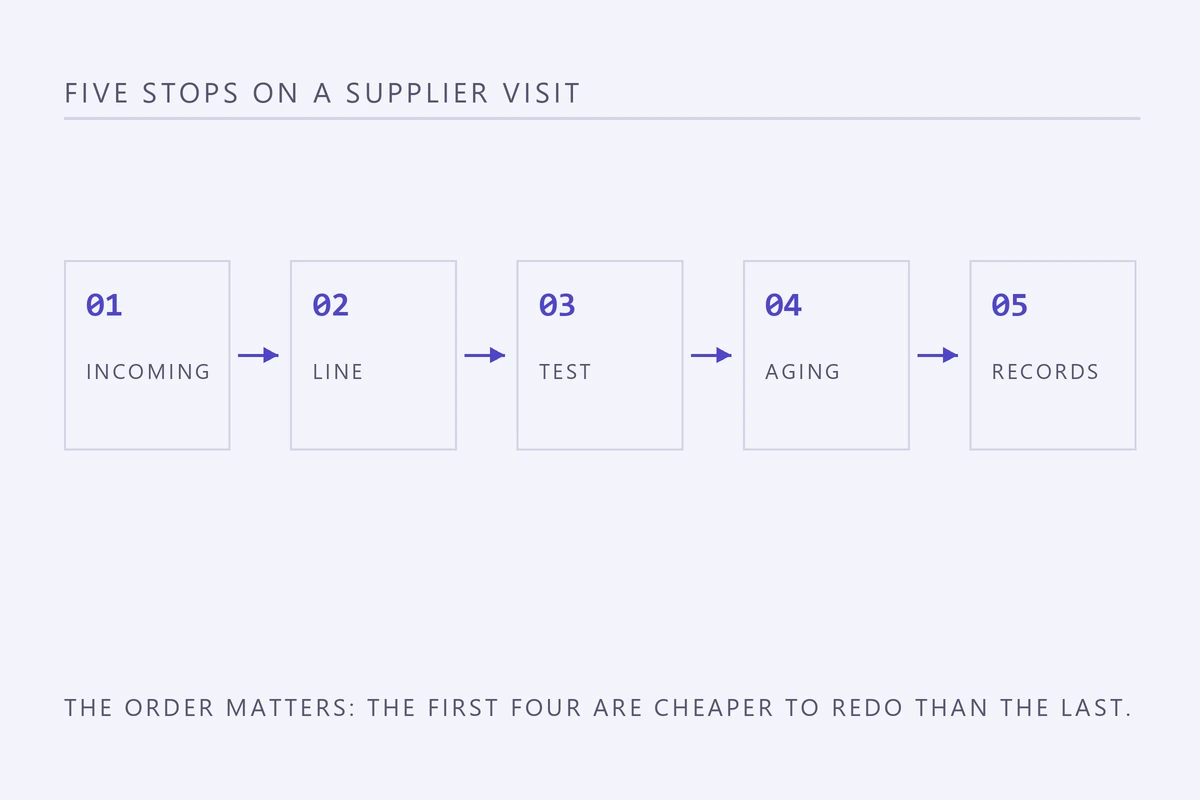
Read the stops as a chain rather than a list. A fault caught at the door costs a coil, and the same fault caught at packing costs a shipment. The further along the chain a problem is found, the more of the chain has already been paid for, which is why the visit starts at the goods in and ends at the file.
Stop one: the goods in
Ask for the incoming record on the coil, the board, the shield and the housing. The interesting part is not the acceptance sheet, which will be tidy. It is the rejection record and what happened after it: a lot returned, a lot sorted, a lot used with a note. All three are defensible, and a supplier who cannot produce the record is telling you that nobody looks.
Then ask what is measured on arrival and what is only counted. Counting cartons is not inspection, and a coil with the wrong inductance looks exactly like a good one in a sealed bag. A line that measures inductance or resistance on a sample has a reason to keep its meter calibrated, and a calibration sticker with a date on it is worth more than a poster on the wall.
Stop two: the line and the fixture
On the line the questions are about placement and rework. How the coil is located, whether the shield goes in on a jig or by hand, and what happens to a unit that fails the first test. Rework is not a fault in itself. Undisclosed rework is.
The functional test is where most visits are won and lost. A fixture that lights a lamp and counts as a test proves that the unit switched on. Ask what the fixture measures: the negotiated profile, the input current at a fixed load, the coil current, the temperature after a fixed time. Then ask what the fixture cannot see, because a supplier who can name the blind spot has thought about it and one who cannot has not.
Stop three: the aging rack
An aging rack is the cheapest insurance in the building and the easiest thing to fake. A rack that powers the coil for an hour proves very little. One that runs a full cycle, records the temperature at the end and keeps the record per lot proves the heat path, which is the part of a wireless charger that decides reviews rather than returns.
Ask how a unit that fails on the rack is handled and whether the failures are written down by lot. A supplier who records by lot can tell you when a change of coil vendor arrived. One who records a monthly average cannot, and that average is the number a buyer is usually shown.
Stop four: traceability
Traceability is the ability to walk from a carton back to a lot of coils, and back again. Look for a date code or a serial on the unit that matches the carton label, and check that the model number on the label is the model number in the certificate file. A certificate covers a model and not a family, so a box that names the family is a document problem that becomes a border problem.
Then the small test that tells you whether the system is real. Pick a carton at random and ask which lot of coils is inside it. A supplier with records answers in a minute. A supplier without them answers with a story about the packing line.
Stop five: the file that leaves with you
The last stop is the paperwork, and it is the only one whose output you can read again at home. Ask for the certificate file for the model you are buying, the test report for the build, the market documents for the destination, and the packing specification. Add the coil and board datasheets, because a change of either is a change of product even when the part number stays the same.
| Stop | What to see | What to take away |
|---|---|---|
| Goods in | The rejection record, not the acceptance sheet | The lot disposition and a calibration date |
| Line and fixture | What the test measures | The fixture specification and its blind spots |
| Aging | A full cycle with a temperature record | The failure record by lot |
| Traceability | A carton matched to a lot of coils | The date code or serial scheme |
| Files | The certificate for the model you are buying | Certificate, test report, market documents, packing spec |
Two of those five lines are documents and three are things you have to stand in front of. That ratio is the reason an audit is a visit rather than an email, and the reason a visit with no documents at the end has produced nothing you can act on.
An audit does not prove a product is good. It proves the supplier can tell you what it did, which is the condition for finding out later.
Updated 2026-10-28 · 4 min read. Specifications and profiles change without notice; confirm the current sheet before you publish a retail claim or a tender document.
Questions that come back
Short answers, before the email.
How long does a supplier visit take?
Long enough to see one full cycle on the aging rack and the packing line running. A visit that starts and ends at the meeting room is a presentation, whatever the agenda says.
Can an audit be done remotely?
The documents can, the rack cannot. A walk through the line on video is better than nothing, and a video of a full cycle with a meter in frame is the only remote evidence worth accepting.
What if the supplier will not show the aging rack?
Treat it as an answer. A rack that is not shown is either not running or not recorded, and both mean the heat path is unproven for the first production lot.
Does an audit replace a sample test?
No. The visit is about whether the supplier can repeat what a sample did, and the sample is about whether the design works at all. Two different questions, and a programme needs both answers.
Which document matters most?
The certificate file for the exact model, because it is the one document a customs officer or a marketplace reviewer can check without your help.
Send the phone list, get the configuration.
Build, profile and the certificate list for each line item, in one reply.