Wireless charger certifications: what each market asks for
A Qi2 certificate proves that a charger was tested to a profile. It proves nothing about whether the product can be sold in Frankfurt, Seoul or Osaka, because market entry is a second and separate set of files. That second set is the one that stops a container at the border, and it is decided months before the artwork goes to print.
Two questions, two sets of paper
The first question is the charging profile. Qi2 and Qi2.2 are separate entries per model, registered with the Wireless Power Consortium, and the model number is checkable in a public database before a purchase order is signed. That check takes twenty minutes and it tells you what the charger does on a phone, which is the subject of the profile guide.
The second question is whether the product may be placed on a given market at all. The answer comes from the regulator rather than from the charging standard, and it is about electromagnetic compatibility, electrical safety, the materials in the housing and the markings on the label. A charger with a flawless profile entry and no market file is unsellable in every one of those markets, and the profile entry does not help at the border.
The four files a market entry asks for
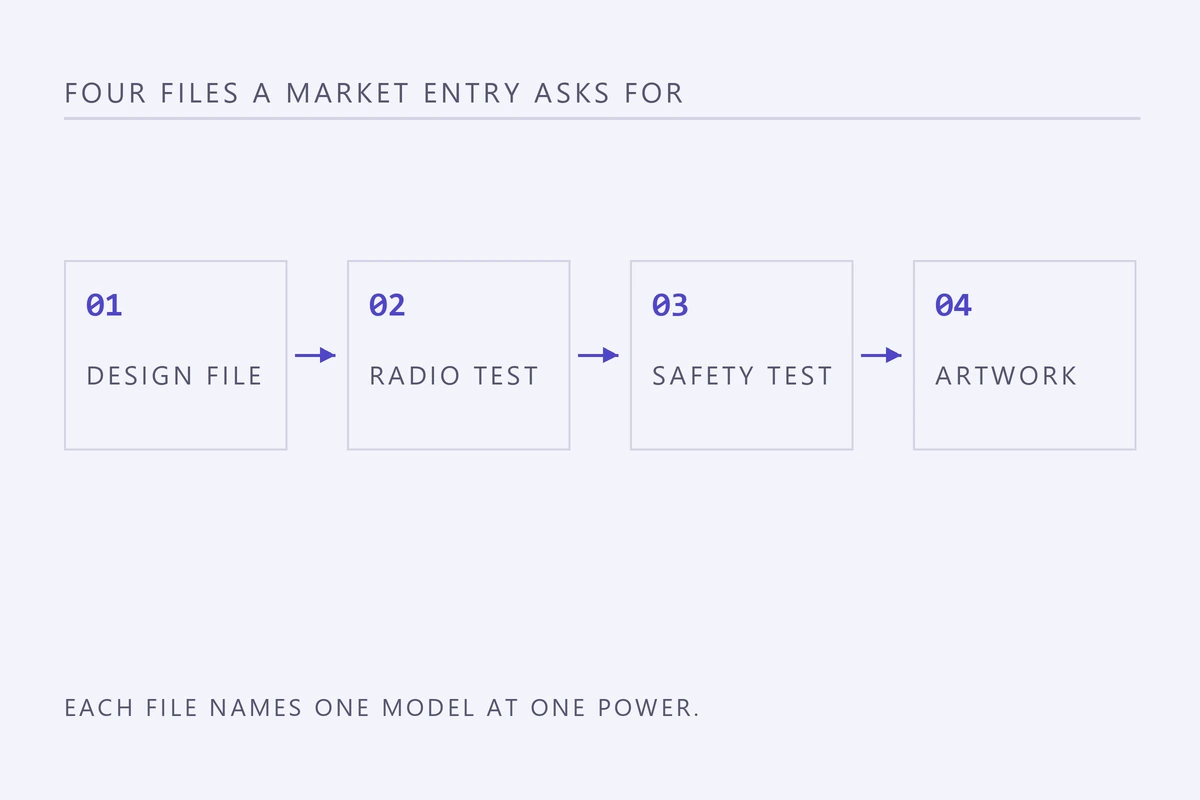
Most markets want the same four things in different paperwork. First a design file: schematics, the bill of materials, the board layout and a description of the coil and the shield. Second the radio test, which is an emissions and immunity report from an accredited laboratory, run on the model you intend to sell. Third the safety test on the mains side and the enclosure, which is where an adapter in the box changes the scope. Fourth the artwork: the mark, the model number, the importer, and a local address where the market asks for one.
The gaps are almost never in the hardware. They are in the fourth file. A label that carries the mark and not the model, or the model but not the importer, is the finding that turns a routine inspection into a hold, and it is a print run away from being fixed at any point before the carton is sealed.
Whether the coil counts as a transmitter
One question splits the routes, and it is worth asking a test house early: does this market treat the coil of a wireless charger as a radio device, or as an unintentional emitter? The answer decides which standard the report cites, which mark goes on the product, and whether a radio approval is in the file at all. Two markets can land on opposite answers for the same hardware, and a file written for one is not evidence for the other.
Hedging in the paperwork is not possible. The declaration names the standards, so the route is fixed by the market before the test is booked. Ask for the test plan in writing and check the standards it cites against a comparable product already on that market's shelf. That comparison is faster than reading the directive.
The model on the box is the model in the file
A report names one model at one power. A 15 W board and a 25 W board are two models even when they share a housing, and a new housing can need a new emissions run even when the electronics are unchanged. The Qi2.2 25 W build shows why: a higher input, a different power stage and a longer thermal path are a different subject for the same test.
Three changes trigger a new file more often than buyers expect: a new adapter or cable in the box, a change of coil or shield supplier, and a move to a housing material that shifts the emissions or the creepage. Ask the supplier which of the three the quotation already covers, in writing, before the tooling is released.
A pack travels under a second set of rules
Anything with a lithium cell carries a transport file on top of the market file. The cell and the pack need the transport test that air and sea freight ask for, and the summary of that test is what a forwarder requests. The label then needs the watt hours beside the milliamp figure, because 18.5 Wh and 37 Wh are the numbers a carrier and a cabin rule actually read.
A 10000 mAh magnetic pack is a charger, a battery and a radio product by turns, so it collects the most paperwork in the catalogue. It is also the line where a missing summary is discovered on the day the goods move rather than in the file review, which is the more expensive of the two.
A brand that buys a module rather than a finished product inherits one more layer. The module carries its own entry and its own report; the finished product has a different model number and needs its own. The Qi2 PCBA module page lists the points that move when a module becomes a product, and the market file is one of them.
What to ask for before the sample
| Ask for | What it proves | Who signs it |
|---|---|---|
| Report on the model quoted | The hardware was tested as it ships | The laboratory |
| Declaration of conformity | The standards the product is placed under | The manufacturer or the importer |
| Label artwork with the model | The marking matches the file, not the catalogue | The brand that sells it |
| Transport test summary | The pack can move by air or sea | The cell or pack supplier |
| Test plan for the next market | The route is understood before the test is booked | The supplier and the test house |
A supplier who answers all five without a follow up email has done this before. The one who sends a report for a different model is not necessarily dishonest; the sales team and the file simply live in different folders, and the order is what makes them meet. Ask early, while a model change is still a drawing.
The cheapest moment to fix a market file is before the tooling. Once the housing exists, a change of label, of importer or of standard is a re test, a new print run and a delay that never appears in the unit price.
Updated 2026-10-25 · 5 min read. Specifications and profiles change without notice; confirm the current sheet before you publish a retail claim or a tender document.
Questions that come back
Short answers, before the email.
Does a Qi2 certificate cover market approval?
No. The profile entry is a registration with the charging standard body and it describes the charging behaviour. Market approval is a separate file about emissions, safety, materials and labelling, and one does not imply the other.
Is a wireless charger a radio device?
It depends on the market. Some treat the coil as an intentional emitter and some as an unintentional one, and the answer changes the standard, the report and the mark. Ask the test house for the route in writing before the test is booked.
Does a different adapter in the box change the file?
It can. The adapter is part of the mains safety scope and part of what the label describes, so moving from bundled to bare, or to a different adapter, can move the product into a different evaluation.
What does a magnetic power bank need that a desk charger does not?
A transport test summary for the cell and the pack, watt hours on the label, and the carrier paperwork that goes with it. The market file is still needed on top of that.
Can the file be issued in my brand's name?
That is a commercial arrangement between the brand, the supplier and the importer, settled per model and per market. What the file names is what a customs officer and a retailer will read, so it is worth settling before the artwork.
Send the phone list, get the configuration.
Build, profile and the certificate list for each line item, in one reply.