How to verify a Qi2 certification before a sample is approved
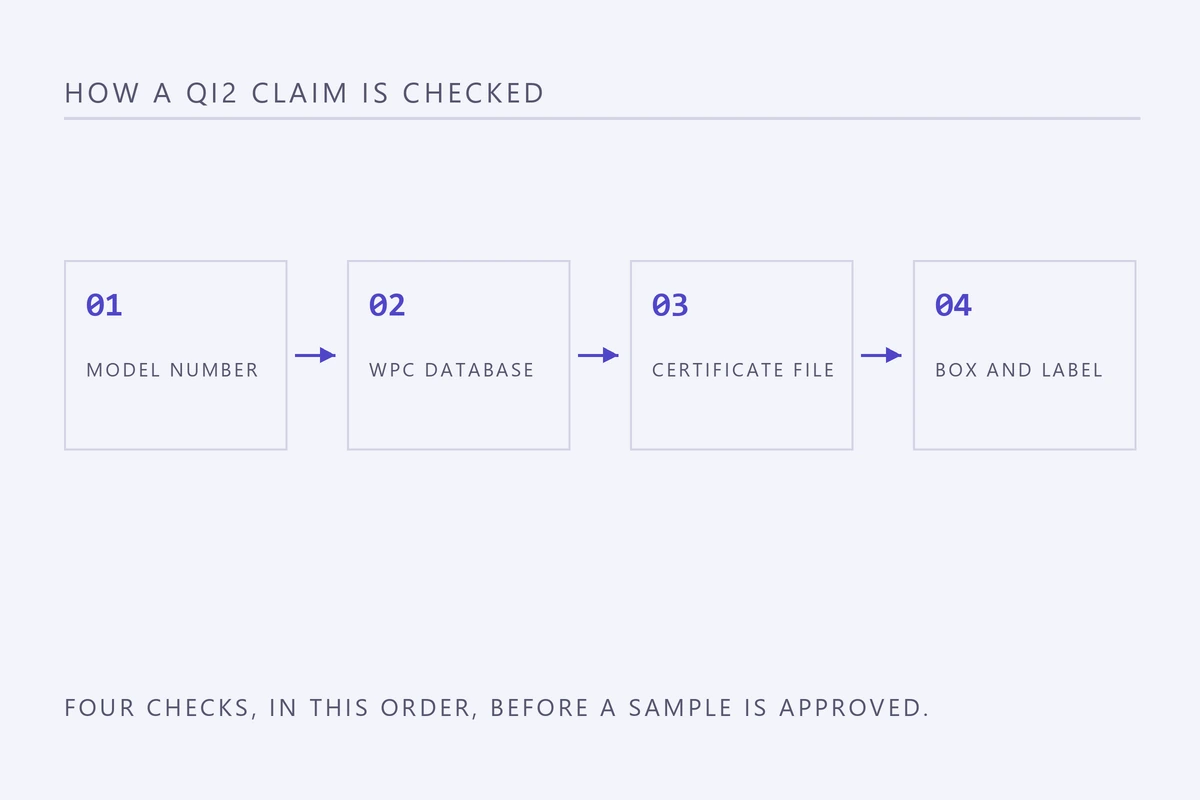
A Qi2 logo on a box is a claim, and a claim is worth what the paperwork behind it is worth. The check takes twenty minutes and needs four things: a model number, the WPC product database, the certificate file and the box. Done in that order, it separates a certified build from a photograph of a certificate.
A certificate names a model, not a category
Qi2 and Qi2.2 are profiles, and a certificate is issued against a specific model at a specific power. A line that says Qi2 charger is not a verifiable statement; a line that says model X, Qi2 magnetic power profile, 15 W is. The same supplier can hold an entry for a 15 W board and none for the 25 W board in the same housing, which is why the model number on the quotation is the first thing to ask for.
The two builds behind most of these questions here are the 15 W Qi2 build and the Qi2.2 25 W build. They are separate entries because they are separate power stages, not because of paperwork.
Step one: get the model number in writing
Ask for the model number on the quotation and on the carton artwork, not only in a chat message. A model string that appears in three places is a model string that can be checked. If the reply is a product line name, a photo of a sample, or a catalogue page with fifteen variants, the claim is not ready to be checked yet.
- On the quotation: the exact model, with the profile beside it.
- On the carton: the same string, in the same characters.
- In the file: the same string again, in the product description field.
Step two: search the database
The WPC product database is public and searchable by model or by certificate holder. Search the model first. If nothing comes back, search the company name and read the list, because a model can be listed under a name the sales team does not use. A hit shows the profile and the power the model is registered at, which is the number that matters. No hit means the claim is not registered, whatever the PDF says.
The database is a register, not a quality ranking. An entry proves that a model was tested to a profile; it does not prove that the unit in front of you is that build. The last two steps close that gap as far as paperwork can close it.
Step three: read the file, not the screenshot
A certificate file carries a product description, a model list, a profile, a rated power and a holder. Read all five. The common failure is not a forgery; it is a real file for a different model, or a model list where the quoted number is the variant added last, or a cropped page image that stops before the description. A screenshot proves that a certificate existed at some point. A file proves what it covers.
| What to read | Where it sits | Why it matters |
|---|---|---|
| Product description | Top of the file | It names the model and the housing the test ran on |
| Model list | Middle | The quoted number has to appear here, not a near miss |
| Profile and power | Description block | Qi2 15 W and Qi2.2 25 W are different entries |
| Certificate holder | Header | The party that holds the entry, which may not be the seller |
| Issue and expiry | Footer | An expired entry is a historical document |
Step four: match the box to the file
The retail claim has to be the certified one. A box that says 25 W needs the 25 W entry for that model, and a box that says 15 W needs the 15 W entry. Mixing them is the failure that reaches a customer: the 15 W board is registered, the 25 W upgrade is not, and the artwork was written for the upgrade before the certificate existed.
The accurate wording is also the safer one. Name the profile and the power, and name the phone models the figure was tested on. A claim of 25 W with no phone named is a support ticket waiting for its first customer.
What the certificate does not prove
It does not prove that the charger holds its rate in your housing, that the thermal design survives a car dashboard in summer, or that the factory is consistent from lot to lot. Those are engineering and process questions, and the answers come from a test report and a sample rather than from a register entry.
- Thermal: surface temperature at the rated power, logged for half an hour.
- Alignment: holding force through the case the product will ship with.
- Consistency: two samples from two lots, tested the same way.
- Foreign object detection: behaviour with a coin or a key left on the pad.
A brand that integrates a module rather than buying a finished charger inherits the same question one level down. The module holds an entry; the finished product has a different model number and needs its own. The Qi2 PCBA module page lists the points that move when a module becomes a product, and the certificate is one of them.
Twenty minutes and four checks is the whole procedure. A supplier who answers all four without a follow up email has been through this before. One who cannot has given you a reason to look at the next quotation.
Updated 2026-10-24 · 4 min read. Specifications and profiles change without notice; confirm the current sheet before you publish a retail claim or a tender document.
Questions that come back
Short answers, before the email.
Is the WPC database the only place to check?
It is the register that matters for the profile claim, and it is public. A test report from a laboratory covers the hardware and the thermal behaviour, which the register does not.
What if the file lists a model family instead of one number?
Then the quoted model has to appear inside that list, spelled the same way. A family entry that stops one variant short of the quoted number is the most common near miss.
Does a Qi2 certificate cover a Qi2.2 claim?
No. They are separate profiles with different power ceilings, so a 15 W entry does not support a 25 W claim on the same housing.
Can the certificate be issued under my brand?
That is a commercial arrangement between the brand, the module supplier and the certificate holder, and it is settled per model. The register is where the result becomes visible.
What should I ask for besides the certificate?
The thermal log at the rated power, the holding force through the shipping case, and the two lot comparison. Those three answer the questions a certificate cannot.
Send the phone list, get the configuration.
Build, profile and the certificate list for each line item, in one reply.