Watch charger compatibility: the model list behind the box
Two watch pucks can look identical and serve different watches. The difference is the module inside and the model list it was tested against, and a box that promises more than that list is a return with a review attached.
One family per module
Phones and earbuds charge on Qi. Watches do not. Each watch family uses a magnetic puck with its own coil geometry and its own communication, so a puck built for one family will not charge another, and the same housing can be sold as two SKUs with different modules inside.
That makes the module the product. One shell sold under two SKUs is normal in this category. One shell advertised as working with every watch family is not, and the claim is visible to the first buyer who owns two watches.
A family list is not a model list
The line that starts the problem is the brand list: five logos, one module, no model named. A buyer reads it as a promise about the watch on their own wrist, which is usually the newest model in the family and rarely the one the module was tested on.
A model list is shorter and far more useful. It names the family, the models tested and the date of the test. It survives a return because it can be checked, and it keeps the copy honest when a new generation of watches arrives without a new module.
Four checks before approval
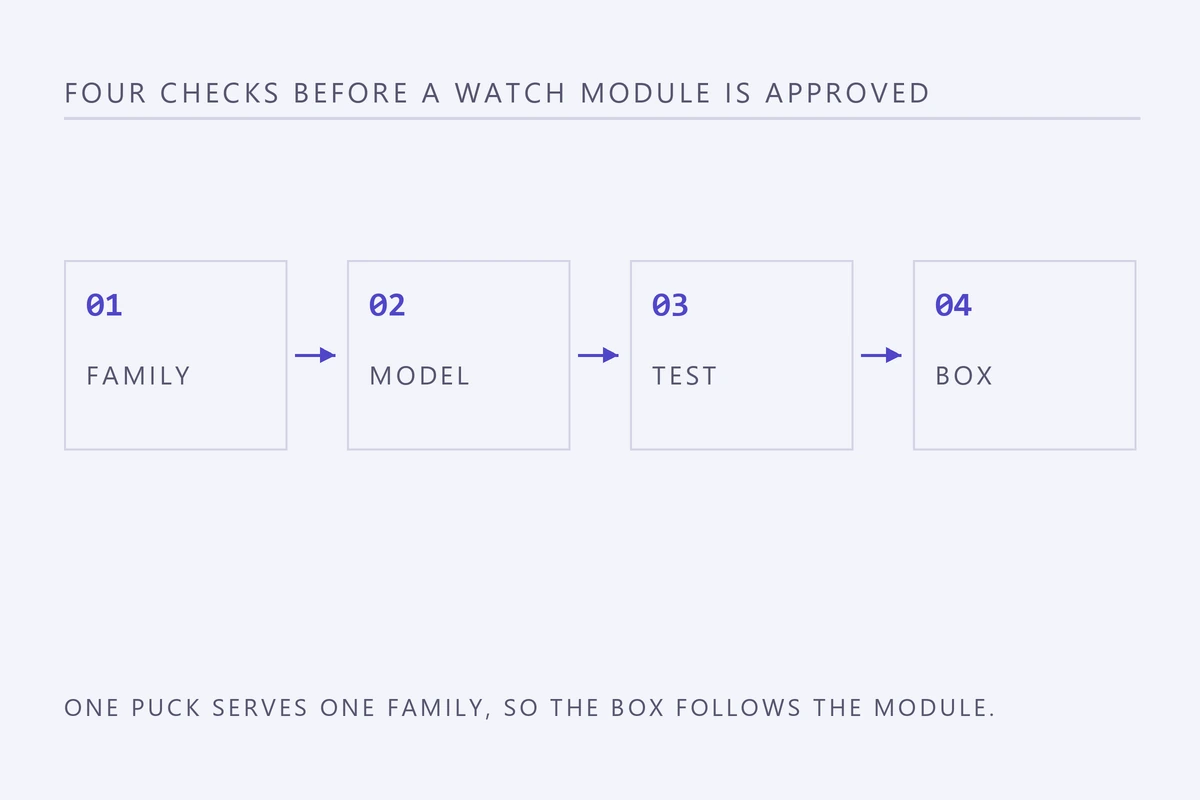
The order matters. The family decides which modules exist at all, the model decides whether the module is current, the test decides what the rate really is, and the box copy is whatever survives the first three. Running them in the other order is how a box ends up listing a family that the module inside cannot serve.
What the stand has to hold
A watch on a puck is held by the puck's own magnet, so the stand does not need a strong magnet. It needs to put the puck where a half asleep hand will land the watch on it in the dark. A cradle that guides the watch onto the module is worth more than a hinge with more angles, and a nightstand is the wrong place to discover that.
The band decides more than the angle. A cradle deep enough to take the watch with the band fitted is a different drawing from one that asks the owner to take the band off every night, and the second will be returned by the buyers who read the manual last. Of the two forms in this line, the single puck is the travel build and the duo stand pairs the module with a Qi2 15W phone coil on one base and one USB-C input, which then has to carry both devices at once.
The test that goes in the file
| Line in the record | What it settles | How to run it |
|---|---|---|
| Watch model | Which promise the test covers | Copy the model number from the case back |
| Starting level | That two runs can be compared | Drain to the same level before each run |
| Time to a stated level | The rate the pair actually reaches | Log the level every fifteen minutes |
| Temperature | Where the heat goes | Puck face and watch case, every fifteen minutes |
| Band on and off | Whether the cradle works in use | Repeat the run with the band fitted |
The point of the table is not the numbers in it. It is that the numbers exist for the model on the box, so a support question six months later has an answer on file instead of a guess. A supplier who can send the completed table for the newest watch in the family has done the work. One who sends a brand list has sent a marketing figure.
Two families in one stand
A stand can carry two modules, which is a duo or a 3 in 1 build, and each output keeps its own family and its own model list. What a stand cannot do is serve every family with one puck. A buyer who needs two families on the same base is buying two modules in one housing, and the drawing has to say so before the tooling does.
That is also how the 3 in 1 line is configured: the watch module is chosen by family first, and the housing is drawn around the modules rather than the other way round.
The same order applies to the artwork. A box designed around a brand list has to be redrawn when the module changes, and the modules change with the watch families. A box designed around a tested model list survives the change, because the list is edited and the layout is not.
The module is the promise. A box that names models is easier to defend than a box that names brands, because a model can be tested and a brand cannot.
Updated 2026-10-29 · 4 min read. Specifications and profiles change without notice; confirm the current sheet before you publish a retail claim or a tender document.
Questions that come back
Short answers, before the email.
Will one watch charger charge an Apple Watch and a Galaxy Watch?
No. Each family needs its own module, and a puck built for one will not charge the other. Two families means two modules, which is a duo stand or two SKUs.
Does the band have to come off to charge?
That depends on the cradle, not on the module. Ask for the stand drawing and repeat the charging test with the band fitted, because a product that only works with the band removed will be returned.
Should the box list brands or models?
Models, with the test date behind them. A brand line is a promise about every model in that family, including the ones the module was never tested on.
What certification does a watch charger need?
The module and the finished product, per market. The compatibility line on the box belongs to the same file, which is why it is written before the artwork rather than after it.
How many models should the box list?
Every model that was tested, and nothing else. A list that grows past the tests is a support problem with a logo on it.
Send the phone list, get the configuration.
Build, profile and the certificate list for each line item, in one reply.