3 in 1 charging station: the five claims on the box
A 3 in 1 charging station is three products in one housing: a Qi2 phone coil, a watch module and a pad for an earbuds case, all fed from a single USB-C input. The hardware is rarely what fails first. The line printed on the box is.
One input, three loads
The station is sold as one product and built as a power budget. The phone coil is a Qi2 transmitter, the watch module is a puck matched to one watch family, and the earbuds pad is a low power Qi coil. All three draw from the same USB-C input, which means the adapter decides what the three of them can do at the same time.
That is the first thing worth checking in a sample room and the last thing a box usually states. A station quoted without an adapter is not the same product at a lower price. It is a product whose performance belongs to whatever supply the buyer already owns.
The phone coil sets the ceiling
Of the three loads the phone coil is the largest, and it is the one that notices a weak input first. The range is built to two profiles, 15W on Qi2 and 25W on Qi2.2, and each one carries an adapter requirement: a 20W class supply for the first, a USB-C PD supply above 25W for the second. Those are single device numbers. In a station the watch module and the earbuds pad share the same supply, so the ceiling has to be read as a total.
A 15W coil on a 20W supply is a sensible match. A 15W coil, a watch module and an earbuds pad on that same 20W supply is a queue, and the queue stays invisible until all three devices are on the stand at once, which is exactly how the product is used overnight.
Heat in a smaller housing
Three separate pads have three surfaces to lose heat from. A station has one, and the watch module usually sits a few centimetres from the coil that works hardest. The losses do not disappear because the housing is tidier. They arrive in a smaller volume.
The behaviour to look for is the order of derating. The phone coil should be the first output to reduce, because it carries the largest load, and the watch module should keep charging at its own rate so the watch is full in the morning. A station that drops the watch output first has its sensor in the wrong place, or one board doing all three jobs.
The five claims a box can carry
| Claim on the box | Survives a return | Why |
|---|---|---|
| Profile of the phone coil | Yes | The certificate names the model and the profile. |
| Watch family and the models tested | Yes | The module serves one family, and the list is the promise. |
| Earbuds pad | Yes | A Qi case either charges on it or it does not. |
| Adapter rating | Yes | It decides what the buyer sees on the first night. |
| One total wattage for the station | No | Three outputs do not add up the way the number suggests. |
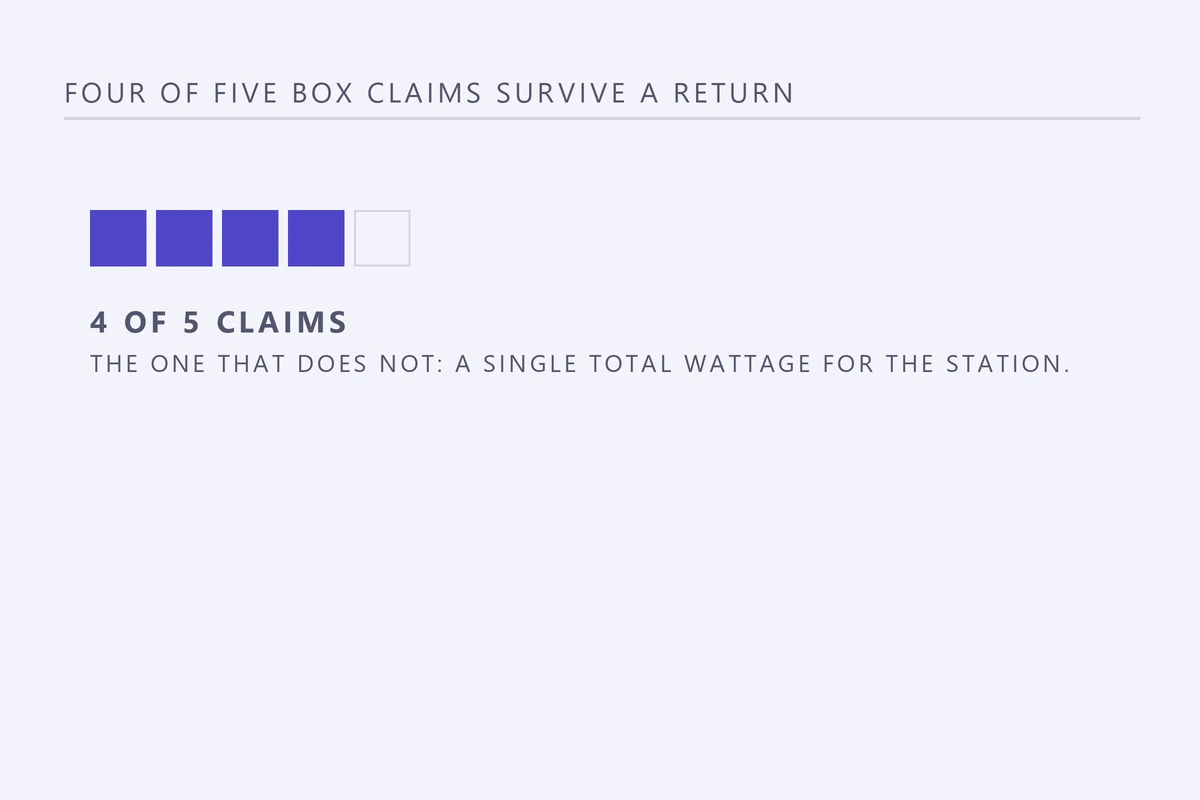
Four of the five survive a return because each one describes a single output, and each one can be tested on a named device. The fifth is the one that comes back. A single total for the station invites a shopper to add up three numbers that were never meant to be added, then blame the product when the supply in the drawer cannot feed them.
What to fix before tooling
- The device list: a phone, one watch family, an earbuds case. Each one adds a module and a load.
- The watch module: one family per puck, and the newest model tested rather than assumed.
- The adapter: in the box, or stated on it. The middle option is a support queue.
- The form: a foldable stand and a desktop stand share the electrics and sell into different channels.
- The test: all three devices at once, for an hour, at the top of the stated ambient range.
The test that settles it
Put the three devices on the stand, use the adapter that ships with it, and write down the charge level of each one every ten minutes for an hour. Note the surface temperature where the phone coil sits and where the watch module sits, because the two are usually different, and the difference explains which output will derate first.
A station that holds all three at a useful rate is a product. A station that holds the phone and lets the watch drift is a support ticket with a battery in it, and one hour on a bench separates the two.
Three outputs on one input is a budget, not a sum. A box that prints the budget is easier to defend than a box that prints a total.
Updated 2026-10-29 · 4 min read. Specifications and profiles change without notice; confirm the current sheet before you publish a retail claim or a tender document.
Questions that come back
Short answers, before the email.
Does a 3 in 1 station charge three devices at full rate at once?
No. The outputs share one USB-C input, and the phone coil takes the largest share. The adapter rating is what decides how much is left for the watch and the earbuds.
Can a buyer use the adapter they already own?
Often, and that is the problem. A 20W class supply runs a 15W coil on its own. With a watch module and an earbuds pad on the same input the station may not hold its stated rate, so test with the smallest adapter you intend to support and state it.
Why does the watch not charge on the phone pad?
A watch is not a Qi device. Each family uses its own magnetic puck, so the station needs a module matched to that family, and nothing on the phone coil will charge it.
Is 25W worth it in a station?
Only if the phone coil is the hero and the thermal budget allows it. A 25W coil beside a watch module in a closed stand is a heat problem before it is a feature.
What goes on the box?
The profile of the phone coil, the watch family and the models tested, the earbuds pad, and the adapter rating. Not a single total.
Send the phone list, get the configuration.
Build, profile and the certificate list for each line item, in one reply.