Foldable vs desktop 3 in 1 charger: the form decides the channel
Both forms charge a phone, a watch and earbuds from one cable. The difference is mechanical, and it decides where the product can be sold: a foldable lives in a bag and is judged at the hinge, while a desktop stands on a nightstand and is judged on how it looks and where the watch sits.
Three coils, two mechanics
Under the plastic both forms are the same electrical idea: a Qi2 15 W coil with a magnet ring for the phone, a module for the watch, and a Qi charging pad for earbuds, fed from one USB-C input. What changes is how the three are arranged and what holds them in place.
| Item | Foldable | Desktop |
|---|---|---|
| Devices | Phone, watch, earbuds | Phone, watch, earbuds, with a 4 in 1 option |
| Phone coil | Qi2 15 W, magnet ring | Qi2 15 W, magnet ring |
| Watch module | Family specific | Family specific, fixed angle |
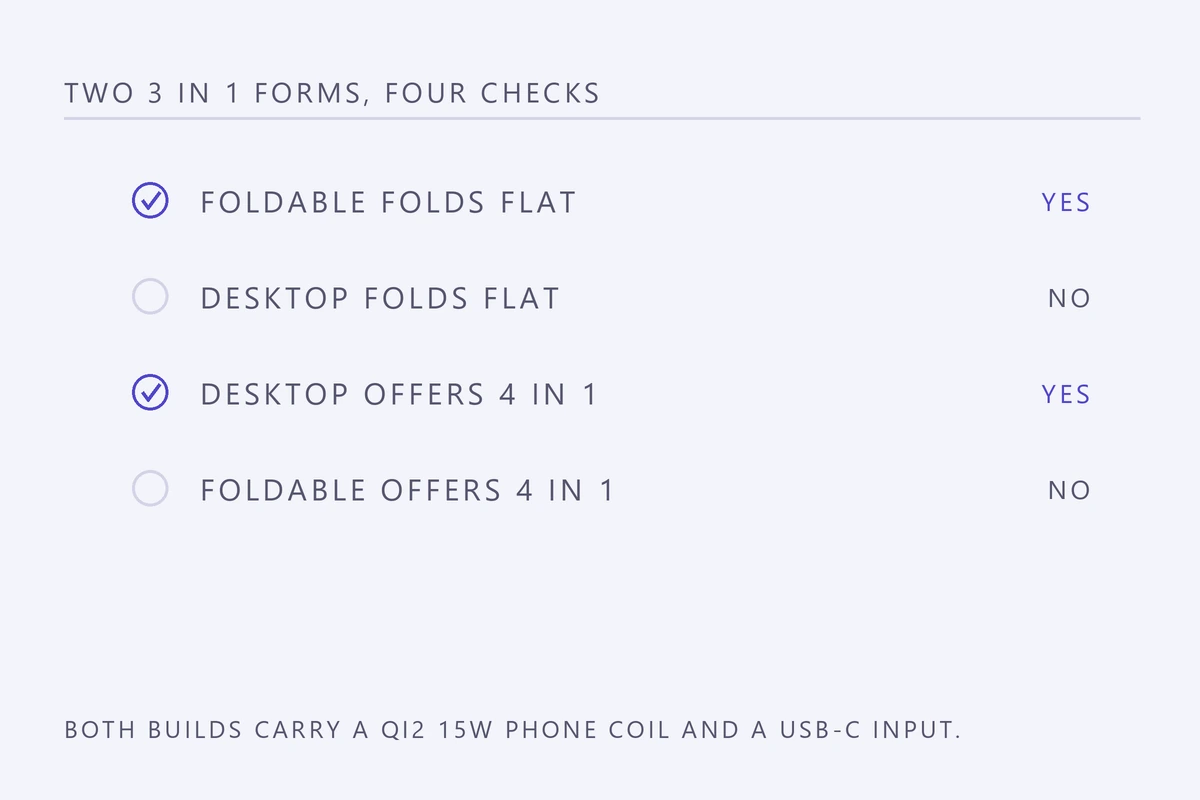
| Form | Folds flat, opens as a stand | Fixed stand, one footprint |
| Input | USB-C | USB-C, rear entry |
| Main risk | Hinge wear, a stand that tips | Height and angle that miss the nightstand |
The hinge is the product
A foldable is judged on a part that does not appear on the electrical sheet. The hinge has to hold a phone at an angle for years, survive being folded twice a day, and not develop the play that lets a phone slide off the ring. Ask for the cycle count and the play measured after the test. A hinge that meets its cycle count and still wobbles is a different product from one that comes back tight.
The second mechanical question is the stand angle. A foldable that opens to one angle is fine for a phone lying flat and wrong for a bedside table, where the phone has to stay readable from the pillow.
The third is where the product stands. A foldable on a duvet, a sofa arm or a hotel desk with a lip will tip if the weight of the phone sits outside the base. Ask for the footprint of the open stand and the phone size the angle was set for, then open it on the softest surface the channel sells into.
What a fixed stand buys
A desktop build trades the hinge for height and cable routing. The watch module can sit at a fixed angle that lines up with the coil every time, the phone stands at a viewing angle that does not drift, and the cable enters at the back so the unit does not walk across the table when the phone is lifted off.
The desktop form also carries a 4 in 1 option in the specification, which adds a fourth device to the same stand. Which device that is depends on the build, so it belongs in the quotation rather than in a web page. The desktop build is the one to specify when the unit never leaves the table.
Packed size is the travel number
For a foldable, the two numbers that decide a retail listing are the packed thickness with the watch module fitted and the folded footprint. Both come from the mechanical drawing, neither appears on an electrical sheet, and both are routinely missing from a first quotation.
The carton follows the packed size rather than the product. A foldable that packs flat can ship in a box the depth of the watch module, which changes the carton cost and the number of units on a pallet. A desktop stand needs a box that protects a fixed arm, which is a second carton and a second pallet count.
- Packed thickness: measured with the watch module in place, not bare.
- Folded footprint: against a phone, for the product photo.
- Hinge cycle count: and the play measured after the test.
- Stand angle: in degrees, and whether it adjusts.
Which channel buys which
Travel retail, gift and online marketplaces buy the foldable, because the box is thin and the product photographs as a closed slab that opens into a stand. Home, office and hotel buyers take the desktop, because it stays in one place, reads as furniture and has nothing to fold.
A brand that sells both should tool them as two products. A hinge housing does not become a fixed stand with a different top plate, and the watch module height differs between the two, which is the detail that decides whether a watch sits on its coil or beside it. The foldable build and the desktop build share the coil, not the mechanics.
A hotel buyer asks a third question: how many units a housekeeping cart can carry, and whether the stand survives being knocked off a bedside table. That is the desktop form in a simpler housing, which is why the same coil appears in both forms with different tooling around it.
What to put in the brief
Four items belong in the first email: the form, the watch families the module has to serve, the packed size limit if the channel is travel, and the phone models the 15 W figure will be claimed against. Everything else follows from the sample, and a brief that starts with wattage has started in the wrong place.
Both forms carry the same Qi2 15 W phone coil. The choice is not about charging speed. It is about a hinge, a footprint and the shelf the product has to stand on.
Updated 2026-10-24 · 4 min read. Specifications and profiles change without notice; confirm the current sheet before you publish a retail claim or a tender document.
Questions that come back
Short answers, before the email.
Can a foldable replace a desktop stand?
For a phone and a watch, yes. It loses on watch angle and cable routing, and it gains a packed size that fits a bag, which is why the two sell in different channels.
Does the foldable charge as fast as the desktop?
Yes. Both carry the same Qi2 15 W phone coil with a magnet ring, so the phone sees the same profile and the same fallback.
What is the 4 in 1 option?
A fourth device on the same stand. The specification lists the option on the desktop form only; which device it adds is confirmed per build, and it should be settled before the housing is tooled.
Which watch families are supported?
The module is family specific, so the answer is per model rather than per product line. Name the watch families in the brief and ask for the module list in writing.
What wears out first on a foldable?
The hinge, and then the surface it stands on. Ask for the cycle count and for the play after the test, and check that the stand holds an angle on a soft surface.
Send the phone list, get the configuration.
Build, profile and the certificate list for each line item, in one reply.