Magnetic power bank: what stops it falling off
A pack is the heaviest thing a magnet ring is asked to carry, and it is carried while the owner walks, sits down and pushes the phone into a pocket. Most complaints about magnetic packs turn out to be mechanical before they are electrical.
A pack is a load, not an accessory
A phone on a desk stand sits still. A phone with a pack on it goes into a bag, a coat pocket and a car seat, and every one of those moves the load sideways. The ring holds the two coils together, which is what makes the charge efficient. Holding the pack on is a second job that the same ring does with a great deal less margin.
That is why the useful specification line is not the magnet grade. It is the mass the ring is rated to hold, on the phone it was designed for, with the case the market actually uses. A figure with no phone and no case attached to it belongs to a test rig rather than to a product.
What the ring holds, and what it does not
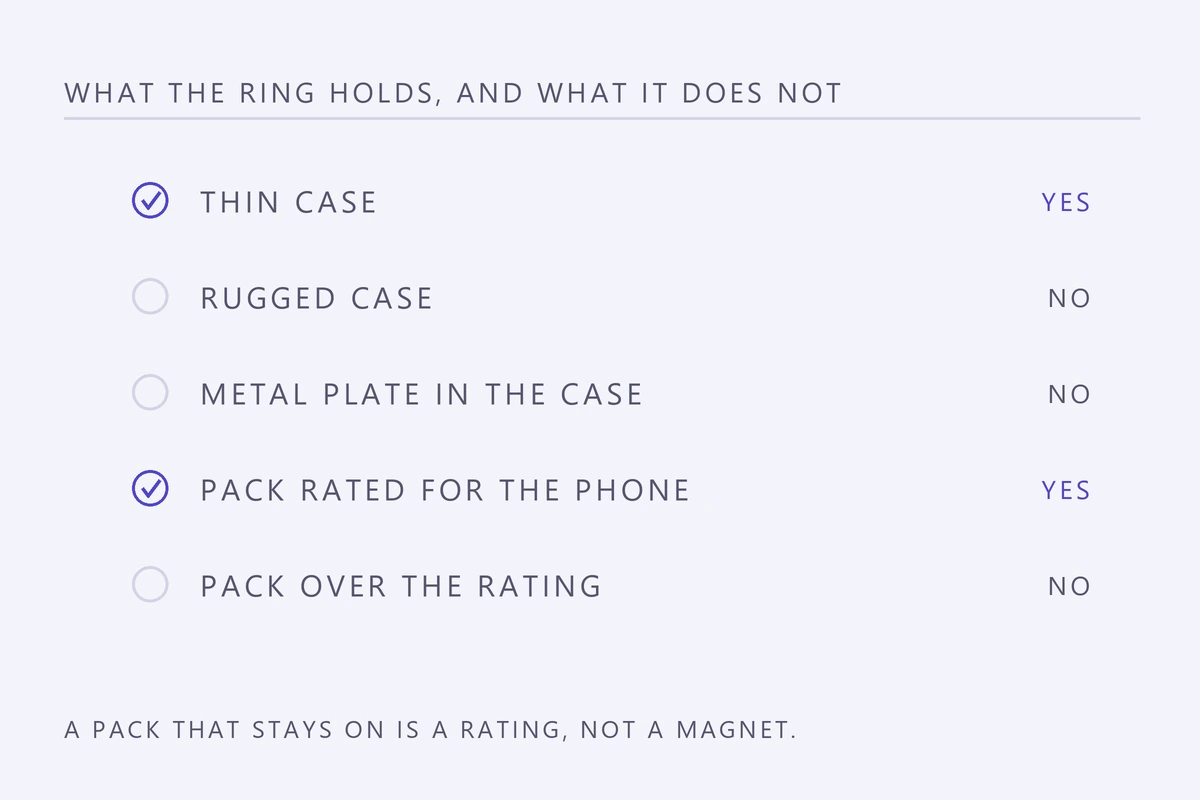
The five rows above decide the answer, and they are worth reading as a set. A thin case passes the field and the ring holds. A rugged case and a wallet case put material between the coils. A metal plate inside a case is worse than distance, because it takes the field the coil was going to use, so it holds the pack firmly and stops the charge.
The two rows that pass are the two a supplier can control: a case thin enough to hold through, and a pack whose mass the ring is rated for. The three that fail are the three a brand has to write into the manual, because no magnet fixes a wallet flap.
The case is half the decision
Ask what case the ring was tested through, named as a product or as a thickness, and then look at the case the target market buys. A market that buys rugged cases needs a different ring from a market that buys thin silicone, and one product rarely serves both.
The manual line matters more than the specification sheet here. A printed sentence that names the tested case prevents a category of returns, and a support script that asks for the case first saves a replacement shipment.
The pack's own mass
In this range the pack comes as a 5000 mAh build and a 10000 mAh build, and the larger one carries a second cell, a bigger board and a thicker shell. More capacity means more mass on the same ring, so the pack that feels comfortable in a hand is the one that lands on a car park floor.
Mass also moves the working point of the ring. A pack that is heavier than the ring was rated for does not usually fall off on the first day. It creeps, a little at a time, until the two coils are no longer on top of each other and the charge rate drops without anything having visibly broken.
The mechanical test is a corner drop with the pack attached, onto a hard floor, from hand height while walking. Five drops, a different corner each time. A ring that lets the pack shift on the third drop has told you what a review will say six months after launch.
Heat under a pack
A pack and a phone clamped together have two heat sources and one exposed surface, and the surface that would normally shed heat is the one under the pack. The pair reaches its limit earlier than either would alone, and the owner experiences that as a pack that slows down before the phone is full.
The answer is not a stronger magnet. It is a thermal path inside the pack, a housing that can convect at the edges, and a derating temperature that is stated on the sheet rather than discovered by the customer.
That temperature belongs on the sheet next to the capacity, not in a support answer. A pack that holds a fast rate for a while and then cuts back is behaving correctly, and a buyer who knows the order of those two events keeps the product instead of returning it.
What to put on the drawing
| Line on the drawing | What it settles | How to check it |
|---|---|---|
| Rated mass on the ring | Whether the pack stays on in a pocket | Hang the pack, walk, sit, pocket the phone |
| Case tested through | Which markets the product can be sold into | Fit the case the market uses and repeat |
| Drop point | The corner that fails first | Five corner drops with the pack attached |
| Derating temperature | When the pair slows down | Log the rate and the pack surface for an hour |
| Manual line | Whether the buyer learns the limit | Read the line, then hand the box to someone else |
None of the five is expensive to add and all of them are cheap to leave out, which is why they are usually left out. The pack that earns a review saying it fell off is the one whose drawing never carried a mass.
A magnet holds what it was rated to hold, on the phone it was rated on. Everything past that is a test the customer runs for you, in public.
Updated 2026-10-28 · 4 min read. Specifications and profiles change without notice; confirm the current sheet before you publish a retail claim or a tender document.
Questions that come back
Short answers, before the email.
Will a magnetic pack hold a phone in a pocket?
It holds if the ring is rated for the pack's mass and the case is thin. A pocket is a sideways load, so a pack that passes on a desk can still shift in a tight one.
Does a metal plate help a pack stay on?
It holds and it stops the charge. A plate takes the field the coil needs, so it feels more secure and charges worse, which is why the manual has to rule it out.
Why does the pack slow down before the phone is full?
Usually the pair has derated. The pack and the phone share one exposed surface, so the combination reaches a temperature limit sooner than either part alone.
Should a brand sell one capacity or two?
Two if the ring is rated for the heavier pack and the manual names the limit. One if the larger pack would need a different ring, because then it is a different product.
What should a support script ask first?
The case. It is the single answer that explains most reports about a pack that shifts or a charge that stops early.
Send the phone list, get the configuration.
Build, profile and the certificate list for each line item, in one reply.