Wireless charging heat: where the watts go instead of the phone
A magnetic charger has two losses and one budget. The losses are the conversion inside the charger and the coupling across the air gap, and the budget is how much heat the housing can shed before the charger decides to slow down. The peak wattage on the box describes none of it.
Two losses, one budget
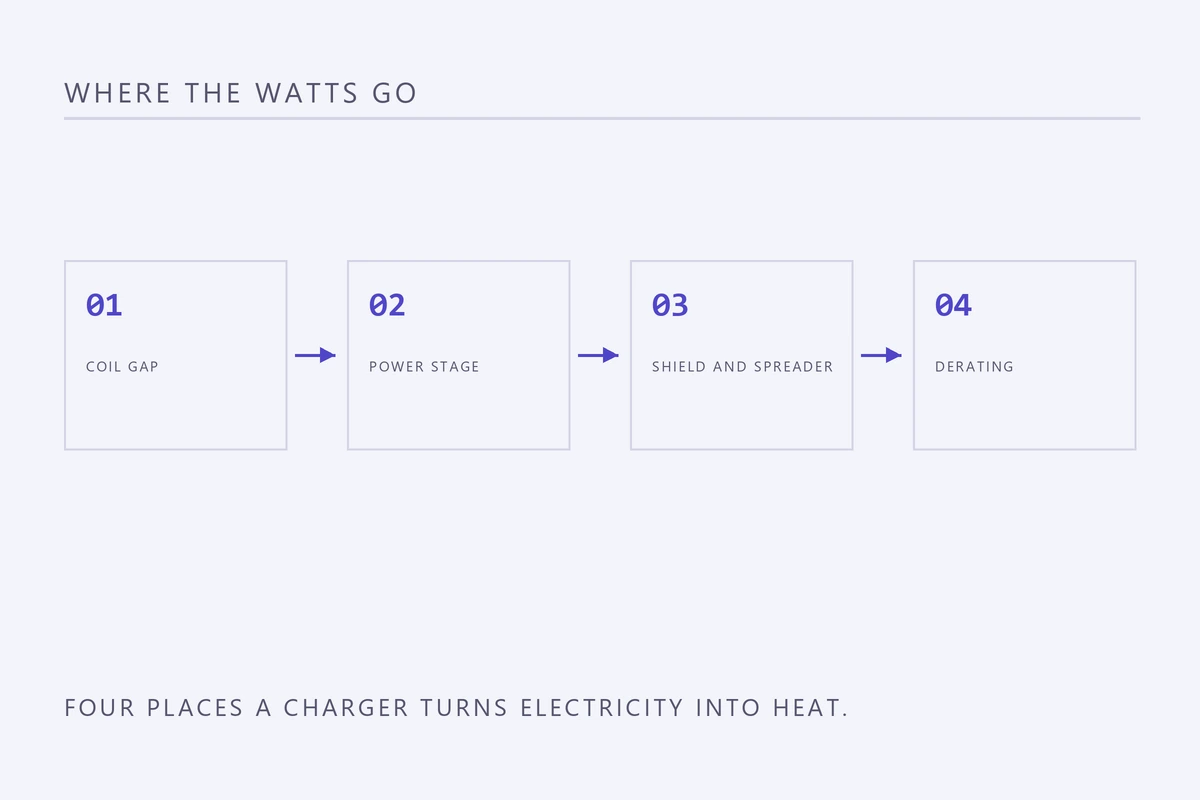
Wireless charging is not a wire. The charger takes USB-C power, converts it to an alternating current at a switching frequency, and drives a coil. The receiver in the phone picks up what crosses the gap, rectifies it and feeds the battery. Every conversion has a loss, and a loss that is not radiated leaves as heat in the part that produced it.
The second loss is the gap. A magnetic pair is more efficient than a flat pad because the rings hold the two coils on top of each other, but coupling is never complete: part of the field returns through the shield, and the phone's own receiver warms up as well. A working figure is 60 to 70 percent of nameplate energy reaching the phone through a magnetic coil, and the rest is heat that both ends have to get rid of.
Why the higher ceiling is not twice as easy
Doubling the delivered power roughly doubles the loss, and the housing does not grow with it. A 25 W build needs a larger controller, more capacitance and a bigger coil, so the bill of materials grows before the enclosure does. With less room for the same dissipation, the charger reaches its temperature limit lower down the charge, and the visible result is a 25 W product that spends part of the hour behaving like a 15 W one.
None of this is a defect. It is the product choosing a temperature over a number, and it is the reason a charger can be honest about its ceiling and still feel slow in the hand.
What the charger does about it
The heat path inside a charger is short and specific. A ferrite shield keeps the field out of the electronics, a spreader of graphite or aluminium moves the heat sideways to a surface that can convect, and the housing has to be able to lose that heat to the room. A sealed shell with no air movement looks better on a shelf and behaves worse on a desk at 25 W.
Derating is the last part of the path. A thermistor on the coil or on the board measures the charger's own temperature, the controller reduces the rate in steps, and the phone reports a slower charge or a temperature warning. The temperature at which that happens describes the user experience better than the wattage on the box, and it is a number the supplier either has or does not.
The phone is half of the problem
The receiver sits against the battery, in the warmest part of a phone that is also running a screen, a radio and a processor. A thick case adds distance between the coils and reduces coupling, and a case with a metal plate or a magnet array of its own changes the field in ways the charger cannot compensate for.
Placement decides the rest. A phone on a dashboard mount in the sun starts the charge already hot, and a phone left under a pillow at a bedside has no way to shed what it gains. The same charger that holds its rate on an open desk will step down in a car, and nothing inside the charger has changed.
What to put in the specification
| Number | What it settles | Where it lives |
|---|---|---|
| Derating temperature | The rate a user actually gets | The specification sheet |
| Time at peak | Whether the ceiling is a moment or a rate | The test report |
| Surface temperature at derating | Whether the product is safe in a hand | The safety file |
| Fallback rate | What a phone without the profile sees | The compatibility list |
| Phone list | Which models reach the ceiling | The claim on the box |
- Derating temperature: measured on the housing, not on the coil, because the housing is what a buyer can check.
- Time at peak: minutes, and from what starting temperature.
- Surface temperature at derating: the figure a safety file and a hand both care about.
- Fallback rate: the rate a phone without the newer profile receives from the same charger.
- Phone list: the models the ceiling was measured on, not the family.
What the box should say
A retail claim has three parts: the profile, the ceiling and the phones. Qi2 at 15 W and Qi2.2 at 25 W are separate entries, so the profile belongs beside the number rather than in a footnote. The phones the figure was measured on belong on the same panel, and so does the adapter, because a 25 W charger on a 20 W supply is a 20 W charger with a marketing problem.
That is not a copywriting exercise. It is the difference between a claim a reviewer can repeat with the product in hand and a support ticket with a screenshot attached.
Heat is not a defect to design out. It is a budget to spend, and the shield, the spreader and the housing are where a brand buys the difference between a charger that holds its rate for an hour and one that holds it for five minutes.
Updated 2026-10-26 · 4 min read. Specifications and profiles change without notice; confirm the current sheet before you publish a retail claim or a tender document.
Questions that come back
Short answers, before the email.
Why does the phone say charging slowly?
Usually the charger has derated, or the pair has negotiated a lower rate. Both are normal: the charger reduces power when its own temperature reaches a limit, and the phone reports what it is receiving.
Does a 25 W charger run hotter than a 15 W one?
At full rate it has roughly twice the loss to shed. On a phone that only negotiates 15 W it behaves like a 15 W charger, which is why the phone list matters more than the ceiling.
Does a thick case make the charger hotter?
Yes. Distance between the coils reduces coupling, so more of the input becomes heat for the same delivered charge. Check the ring through the case that will actually be used.
Is a fan inside a charger a good sign?
It moves heat, and it adds noise, a wear item and a warranty question. Ask whether the rated figure depends on the fan running.
What should a buyer ask for instead of a peak wattage?
The temperature at which the charger derates, and how long it holds the ceiling before that. A peak figure without either is a brochure number.
Send the phone list, get the configuration.
Build, profile and the certificate list for each line item, in one reply.