Wireless charging module: what ships and what the enclosure owns
A module is the half of a charger that makes the field and none of the parts a buyer can hold. The other half is an enclosure, and three of the five lines a retail product needs are decided there rather than on the board.
What arrives in the box
An order for a Qi2 module delivers an assembly: a board with the controller on it, a coil sized to the enclosure it will sit in, and a ferrite shield behind the coil, with a metal back where the drawing calls for one. Power comes in over USB-C PD or a fixed supply, and the detection is tuned on the assembly rather than on the bare board.
That is the whole product, and it is what the Qi2 PCBA build is: a board, a coil and a shield, specified around the buyer's enclosure rather than around a catalogue shell. There is no housing, no cable exit, no gasket and no label. A buyer who has only ever ordered finished chargers usually expects more in the carton, and the first sample round is where the gap becomes visible.
Two lines of five
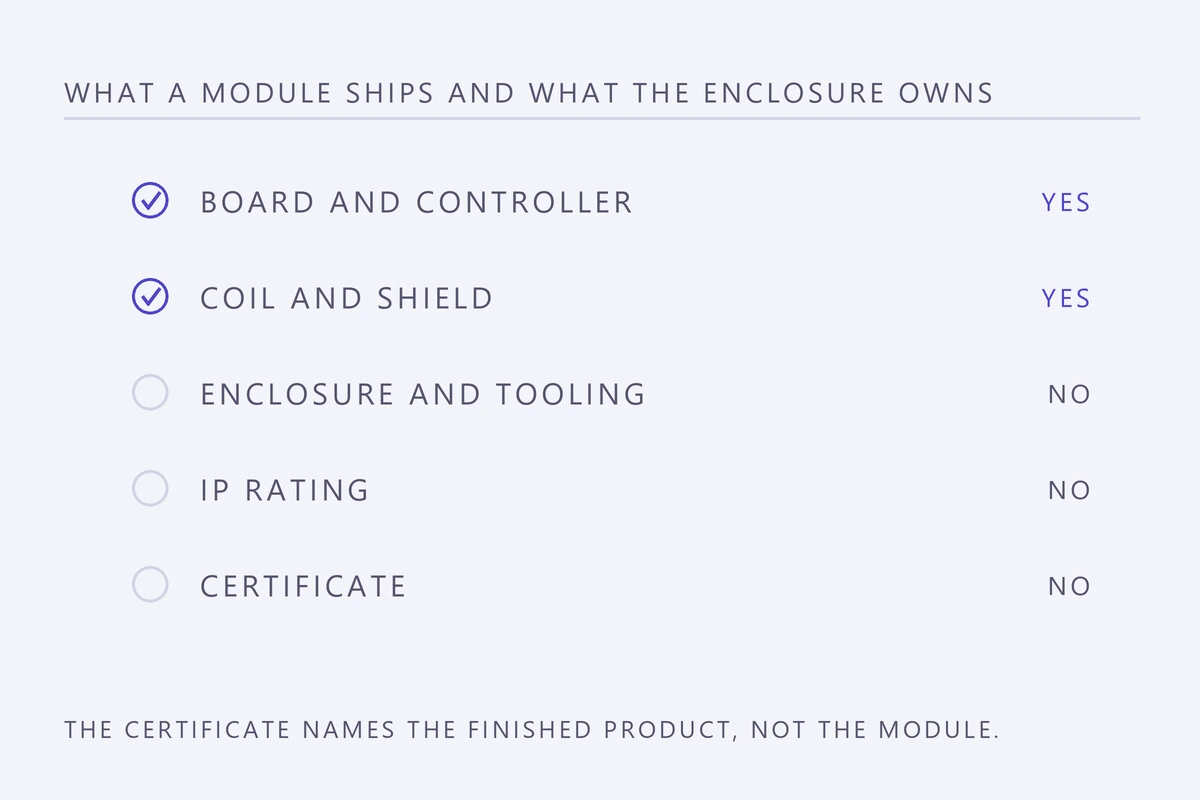
Two of the five lines ship with the module: the board with its controller, and the coil with its shield. Three stay with the buyer: the enclosure and its tooling, the IP rating the enclosure earns, and the certificate, which names the finished product and cannot be issued for a board.
A supplier who quotes a module and a certificate number in the same message has either quoted a finished product or quoted the wrong paper. Both are worth catching before the sample is approved, because neither is visible on the hardware.
The controller sets the profile
15W on Qi2 and 25W on Qi2.2 come from the controller and the coil it drives, so the profile is a decision taken at the module stage rather than at the artwork stage. It is also the last cheap moment to take it: the same housing can carry either board, and the 25W board asks for a USB-C PD supply above 25W and a taller shield and spreader stack behind the coil.
Past that point the profile is a mechanical problem. A housing drawn around a 15W stack has to grow to take the 25W one, and a housing drawn for 25W and shipped with 15W is paying for space it does not use.
The coil distance is the design decision
The coil sits a fixed distance from the phone, and that distance is set by the wall of the housing. Change the wall and the coupling changes, which is why the certificate is issued per model rather than per board: on the 15W line a new housing form is a new model entry, because the coil distance moved.
For a buyer this is the argument for fixing the housing before placing a module order. A module order placed against a finished drawing is a build. A module order placed against an idea is a sample round with a redraw behind it, and the second sample is the one that costs a season.
Heat has nowhere to go
On a bench the module is cooled by open air. In a product it is cooled by whatever the enclosure gives it: a spreader, an air gap, a metal wall, or nothing at all. The losses do not change. The path does.
That is why the derating curve belongs to the finished product rather than to the module. Ask for the curve measured on the assembly in the enclosure, and treat a curve measured on a bare board as a starting point rather than a promise. The finished product derates with the enclosure, and the module cannot know what the enclosure will be.
The IP rating belongs to the enclosure
A module has no IP rating of its own, because the rating describes an assembled item and a module is not one. The gasket, the cable exit and the wall thickness are the rating. The same board can ship as an indoor plate and as a sealed unit with two different numbers on two different cartons.
The line to hold on to is that the number is earned by the thing that goes in the box, and the thing that goes in the box is not the board.
The five lines, and who owns each
| Line | Ships with the module | The buyer supplies |
|---|---|---|
| Board and controller | Yes, and it sets the profile | The choice: 15W Qi2 or 25W Qi2.2 |
| Coil and shield | Yes, sized to the drawing | The enclosure drawing, before the order |
| Enclosure and tooling | No | The drawing, the tool and the colour way |
| IP rating | No | The gasket, the cable exit and the test |
| Certificate | No | The finished product, per model and market |
Read down the third column and the pattern is that a module order needs a finished drawing more than it needs a specification. The specification is the module's business. The drawing is the product's, and it is the buyer's.
What to put in the module order
- The profile: 15W on Qi2 or 25W on Qi2.2, chosen at the controller.
- The coil footprint and its distance from the phone face, taken from the housing wall.
- The supply: USB-C PD above 25W for the 25W build, or a fixed supply per the drawing.
- The shield stack: ferrite behind the coil, and a metal back where the enclosure needs one.
- The test: the assembly in the enclosure, at the top of the stated ambient range, for an hour.
An order with those five lines is a build that can be quoted, tested and certified. An order without them is a sample, and the sample round is where the money goes. It is also where the schedule goes, which is usually the more expensive of the two.
The module is the field and the coil. The product is the wall around it, and the paper comes from the wall.
Updated 2026-10-30 · 5 min read. Specifications and profiles change without notice; confirm the current sheet before you publish a retail claim or a tender document.
Questions that come back
Short answers, before the email.
Can a module carry a Qi2 certificate on its own?
No. The certificate names the finished product and is issued after integration, so a module supplier can show the certificate of a product it built, not of the board it sells.
Can the same module go into two housings?
Electrically yes, and on paper no. Each housing changes the coil distance and the heat path, so each form is its own model entry and its own test.
Does the module include an IP rating?
No. The rating describes an assembled item, and the enclosure, the gasket and the cable exit are what earn it.
Can a 25W module run from a 20W adapter?
It runs and it does not reach 25W. The 25W profile needs a USB-C PD supply rated above 25W, and below that the pair negotiates a lower rate.
Who tunes the detection?
The assembly, which means the module supplier does it on the board and coil together. A change of coil or shield is a retune, not a drop-in substitution.
Send the phone list, get the configuration.
Build, profile and the certificate list for each line item, in one reply.