Wireless charger OEM process: four gates from a device list to a carton
A charger programme that goes wrong usually goes wrong at a gate rather than on a line: the profile was decided before the phone list, the housing was tooled before the sample was tested, or the box claim was written before the certificate existed.
Gate one: the device list
Everything downstream follows the list of devices the product has to charge. A phone list decides the profile: Qi2 at 15W covers a mixed fleet, and Qi2.2 at 25W only shows its ceiling on a phone that supports it. A list that names one premium model and twenty older ones is a 15W product with a 25W sentence in the marketing.
The same list decides the adapter. A 25W build shipped without a supply that can hold 25W is a support ticket, and the box is where the argument starts. Write the device list and the adapter decision on one page before anything is quoted, because both of them reach the housing.
Gate two: the build sheet
The build sheet turns the list into a part: the coil, the shield, the thermal path, the housing, the input and the packing. Two products that look identical on a shelf differ here, and the differences are what a buyer is really choosing between when two quotations arrive at different numbers.
This is also where the minimum order belongs. A PCBA module, a moulded housing and a printed carton are three separate commitments, and a quantity that suits one may not suit the others. Ask for the three lines separately rather than for one number that hides them.
The thermal path is the line most often left off a build sheet and the one that decides the reviews. A charger that holds its rate for half an hour and then slows has a heat path problem, and by the time it is visible in a sample the housing is already cut around the wrong internal height.
Gate three: the sample
A sample is a test object, not a gift. Charge a named phone on it, note the rate and the temperature after half an hour, and repeat on the oldest phone on the list. A sample that is fast on the newest phone and slow on the oldest has told you which profile it really is.
Then the mechanical half: the magnet hold through the case that will actually be used, the button or the touch area, the cable entry, and a drop onto a hard floor from the height of a desk. Keep one unit back, signed and dated, as the reference for the production run.
Expect a second round. A first sample that needs no change is rare, and the useful question is what changed and what was re-tested after it. A housing change moves the coil distance, and a coil distance change moves the charge rate, so a round that only re-tests the artwork has tested nothing.
Gate four: the pilot and the carton
The pilot run is where the artwork meets reality. The compatibility line on the box has to match the profile inside it, the watt hours on a power bank label have to match the cells, and the market documents have to name the model being shipped rather than the family it belongs to.
This is also the gate where a buyer discovers that a certificate covers a model and not a range. If the pilot unit and the certificate name different models, the shipment is held at the border rather than caught before it was loaded.
Pack the carton for the trip it will take, not for the photo shoot. A retail box that opens on a pallet, a tray that lets the unit move, and a label that sits over a seam are the three faults that show up after the units have left and cannot be fixed by a document.
What survives a sample review
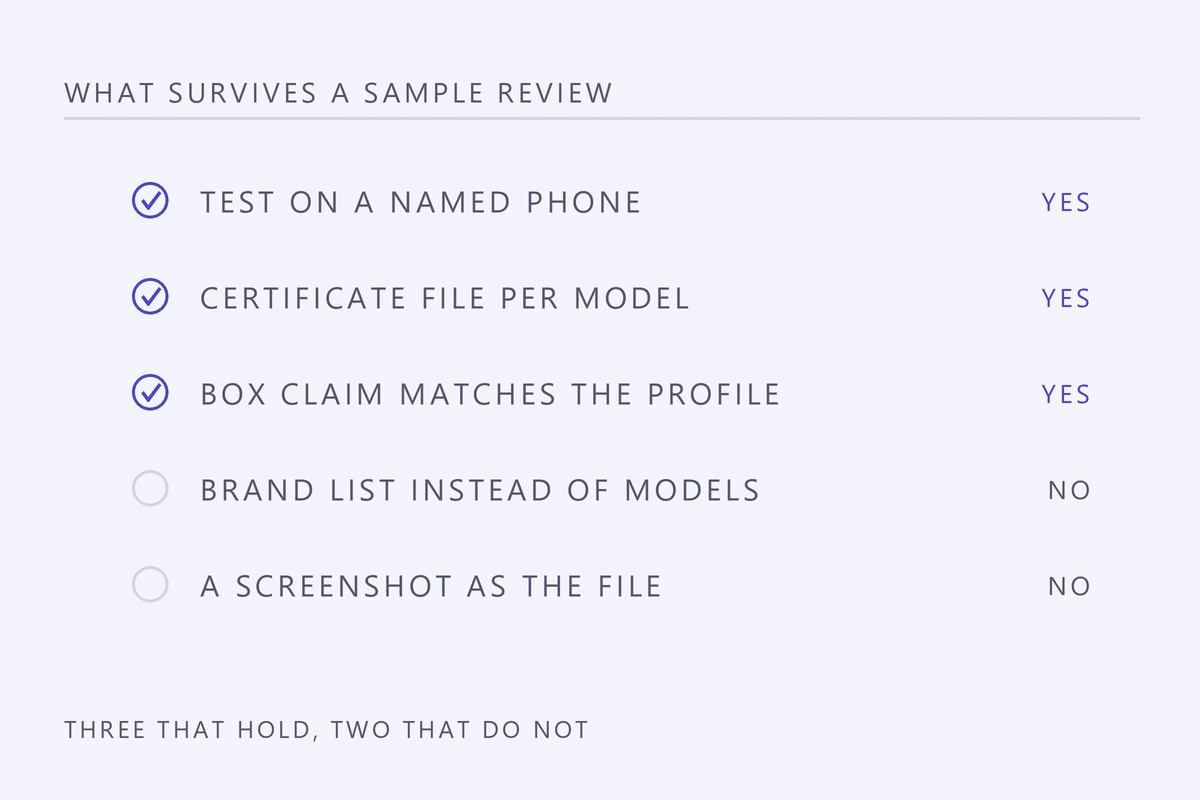
A test on a named phone, a certificate file per model and a box claim that matches the profile are all checkable in an afternoon. A brand list and a screenshot are not, and a review that accepts them has accepted nothing.
What the buyer brings to each gate
| Gate | The buyer supplies | The supplier returns |
|---|---|---|
| Device list | Phones, watches, earbuds and the adapter decision | A profile recommendation |
| Build sheet | Housing direction, packaging, target market | Quotation, minimum order, lead time |
| Sample | The case and the phones it will be tested on | Test unit, charge and temperature record |
| Pilot | Artwork and the market documents | Pilot units and the certificate file per model |
Programmes stall at the gate where the buyer's input is missing far more often than at the gate where the supplier is slow. A quotation that cannot name the market, or a sample that arrives without the phone it will be tested on, adds a week to every round after it.
Four gates, four documents: the device list, the build sheet, the test record and the certificate file per model. A programme that cannot produce those four at the end is a programme that will be hard to defend in a market review.
Updated 2026-10-27 · 4 min read. Specifications and profiles change without notice; confirm the current sheet before you publish a retail claim or a tender document.
Questions that come back
Short answers, before the email.
What decides 15W or 25W in an OEM programme?
The phone list. A mixed fleet is a 15W build, and 25W only pays on a list that can use it. The adapter has to be decided at the same time, because a 25W build behind a weak supply is a support case.
When should a sample be tested?
Before the housing is tooled. A sample that fails on the oldest phone on the list changes the power stage, and the power stage changes the internal height of the housing.
What is a golden sample for?
It is the reference unit for the production run. Signed and dated, it settles an argument about a batch that charges slowly or holds weakly without either side having to trust a memory.
Why does a certificate have to name the model?
Because a certificate covers a model and not a family. A file that names a different model from the one in the carton passes a desk check and fails at a border or a marketplace review.
How many rounds does a programme take?
Four gates, and each one can add a round. The programmes that run to schedule are the ones where the device list and the artwork were settled before the first quotation rather than during the last week.
Send the phone list, get the configuration.
Build, profile and the certificate list for each line item, in one reply.