Wireless charger keeps stopping: the five checks in order
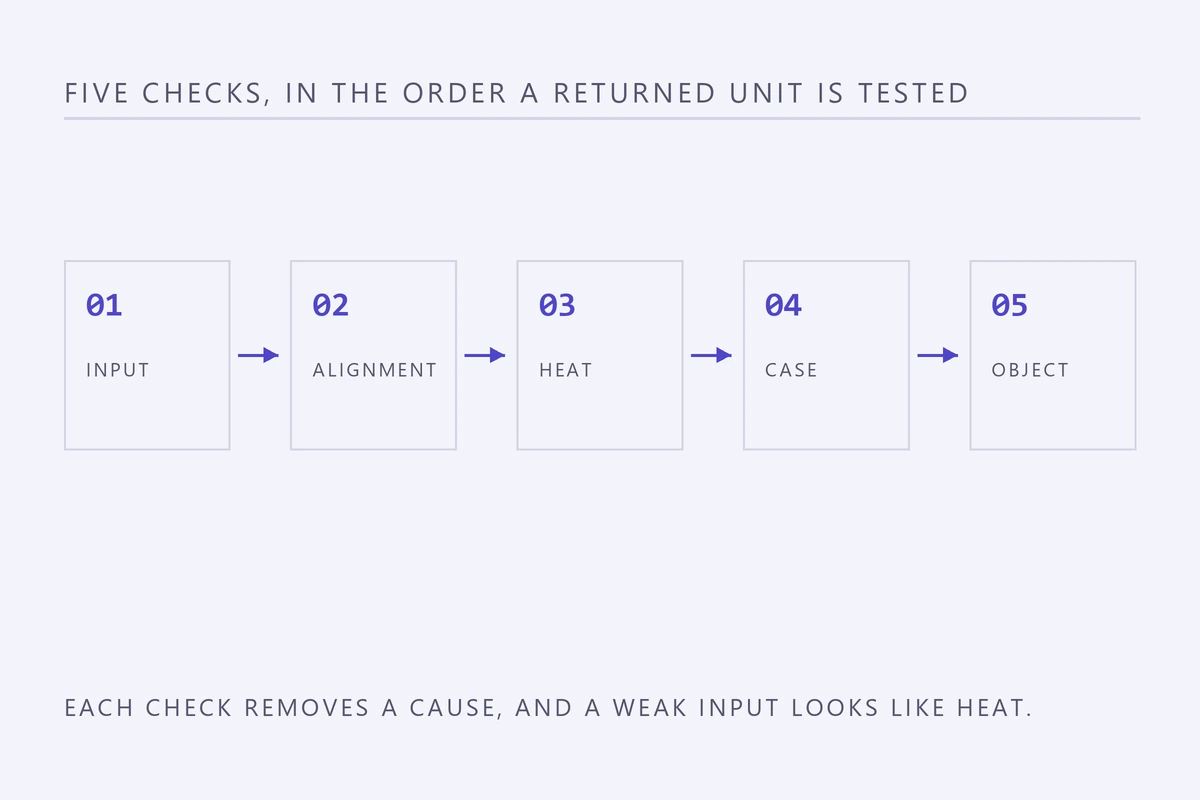
A unit that stops and starts is the hardest return to settle, because it works on the bench and fails on the nightstand. There are five causes worth testing, and the order is what keeps a weak adapter from being written down as a heat fault.
Five causes, one order
Intermittent charging is not one fault. It is a short list: the supply, the alignment, the temperature, the case, and whatever was lying on the pad. Each one produces the same sentence from the customer, which is that it charges and then it does not.
The order matters because the cheapest check comes first and the most expensive comes last. An adapter that cannot hold its rate looks exactly like a coil that overheats, and a bench test in a cool room will show the first while hiding the second.
The supply is the first suspect
A Qi2 coil is a load, and the profile decides what it asks for. The 15W build negotiates at 5 V or 9 V and wants a 20W class supply. The 25W build wants a USB-C PD supply rated above 25W. Feed either one from a port that is sharing its budget with a screen, a second device or a car socket splitter and the negotiation lands lower, so the phone does charge, draws less than the box promised, and the buyer sees a charger that stops.
The check is a photograph of the adapter label and of the port it is plugged into, not a description of either. A laptop dock, a hub and a multi-way socket are the three that come back most often, and all three are working equipment that simply cannot give the profile away.
Alignment is the second
The magnet ring is the alignment mechanism, and it only does its job at the distance it was drawn for. A case with a metal plate, a wallet flap or three millimetres of leather moves the coils apart. A pair a few millimetres off still charges, at a lower rate, and loses the handshake when the phone is nudged in the night.
The check is the same unit with the case off and the phone placed by the ring rather than by eye. If the behaviour changes, the charger is fine and the case is the answer, which is a cheaper reply than a replacement.
Heat is the third, and it is designed in
Every charger in the range carries a derating curve, and the curve is a decision rather than a fault: above a stated temperature the output drops to protect the phone and the coil. On a desk that never shows. In a dashboard mount, on a windowsill or under a pillow it shows every night, and the customer reports the drop as a stop.
The check is a surface thermometer and an hour. Log the charge level and the temperature every ten minutes, and a pair that stops a few minutes after the case warms up is derating rather than failing. The remedy is airflow or a lower profile in the same housing, not a new board.
The case, and the object
The fourth and fifth causes are physical. A case with a magnet array built for a different product can hold the phone firmly and still sit further from the coil, which is the alignment problem under another name. A foreign object is a coin, a key, a card with a chip or a plate left on the pad, and the charger refuses to start, or stops after a few minutes, because that is what the detection is for.
Both are settled in a minute with the case off and the surface clear, which is why they belong at the end of the list. A support desk that starts here spends a week replacing working chargers.
The five lines in the returns record
| Line | What it settles | What to collect |
|---|---|---|
| Adapter label and port | Whether the profile was ever available | A photo of the label, not a description |
| Case, and the gap over the coil | Whether the pair reached its rated distance | The case on a ruler, and the same test without it |
| Surface temperature over an hour | Whether the unit derated | Two readings: coil face and phone back |
| Time from start to the stop | A derate or a disconnect | A stopwatch, not an impression |
| What was on the pad | Whether detection did its job | A photo of the surface |
Four of the five can be collected by the customer in an evening. The fifth takes one question from the support desk, and it is the question that makes the other four worth having.
What the manual and the box should say
A product that states the adapter it needs, the case guidance and the operating range in the manual turns a return into an email. A product that states a peak wattage and nothing else turns an email into a return.
The line worth printing is not the peak. It is the supply, because the supply is the one variable the buyer controls and the one the carton usually leaves out. A charger sold without an adapter is a charger whose performance belongs to whatever is already in the drawer.
A stop has a cause, and the cause is usually outside the charger. The order of the checks is the whole method.
Updated 2026-10-30 · 4 min read. Specifications and profiles change without notice; confirm the current sheet before you publish a retail claim or a tender document.
Questions that come back
Short answers, before the email.
Why does my wireless charger stop when the phone gets warm?
Because the output is derating. The charger reduces power above a stated temperature to protect the phone and the coil, and a customer sees that as a stop. Airflow, a cooler position and a case off the coil all move the point at which it happens.
Does a thick case stop wireless charging?
It can, without stopping it completely. A case moves the coil further from the phone, so the pair charges at a lower rate and can lose alignment when the phone is nudged. Test the same unit with the case off before replacing anything.
Will a 25W charger run on a 20W adapter?
It will run and it will not reach 25W. The 25W profile needs a USB-C PD supply rated above 25W, and with a smaller supply the pair negotiates a lower rate that the buyer reads as an intermittent charger.
Why does it charge on a desk and not in a car?
Two reasons at once. A car adds heat through the glass and the dash, and a car socket often shares its output with other accessories. Both push the pair towards the same derating and negotiation limits.
Can a coin on the pad damage the charger?
The detection is there to prevent that. The charger refuses to start, or stops after a few minutes, when it finds metal on the surface. That behaviour is the feature working, not a fault to be returned.
Send the phone list, get the configuration.
Build, profile and the certificate list for each line item, in one reply.