Where to mount a magnetic car charger: vent, glass or dash
A magnetic charger fails in a car for mechanical reasons far more often than electrical ones. The ring holds the phone, the bracket holds the ring, and the position decides whether the bracket ever had a chance.
The vent decides before the driver does
A vent clip needs a horizontal blade with some spring left in it. That is the fitting the mount is designed around, and it is also the one a car may not have: round vents, vertical blades and blades that move under a finger are the three that turn a good mount into a return.
The clip itself is a spring, and a spring has a cycle count. A clip that holds a phone at rest and lets it rotate after a hundred vent adjustments is the failure a buyer reads about in a review rather than on a specification sheet, so ask what the clip was cycled to before it was approved.
The vent has one advantage nothing else matches. Air moves across the back of the phone, and a phone that is being cooled charges at a higher rate for longer. In a market where a closed car reaches temperatures the phone will not charge through, that matters more than the neatness of the install.
Glass is a surface, not a mount
A suction base on the windscreen is the oldest answer in the category and still the easiest to fit and to remove. It is also the position with the most sunlight on the phone and the one most likely to sit inside the driver's field of view.
Many markets restrict what may be fixed to the glass inside the area the wipers sweep, and the rule is enforced at inspection rather than at the shop. Check the local requirement before fitting, and keep the phone low enough that it blocks neither the road nor the mirror.
The dash has to be flat, and it has to stay flat
An adhesive base asks more of the surface than most buyers expect. A textured dashboard, a curved dashboard and a dashboard with a soft touch coating hold an adhesive for a week and then let go, usually on the first hot afternoon. Leather, vinyl and painted plastic behave differently again.
Test the surface before the bracket goes on. Clean it, press a strip of the same adhesive tape down, leave the car in the sun for a day, and look at what happened. A base that fails that test will fail with a phone on it, and it will leave a mark on the dashboard that the customer notices every morning.
Height, angle and the cable
The phone should sit where a glance costs nothing: below the mirror, above the wheel, and not in front of a vent the driver needs in winter. The angle matters as much as the height, because a ball joint that holds a small phone at rest can rotate under a large one on a rough road.
Then the cable. A plug that enters at the top of the housing fouls the gear lever on some cars and hangs across the screen on others. Route it before the adhesive is pressed, and check that the cable crosses no airbag cover and no control the driver uses.
Reach is the last mechanical question. An arm long enough to clear a deep dashboard also puts the phone where a short driver cannot touch it without leaving the seat, and a short arm forces the base onto a curved part of the dashboard. Measure the reach from the socket rather than from the driver's seat.
The five checks
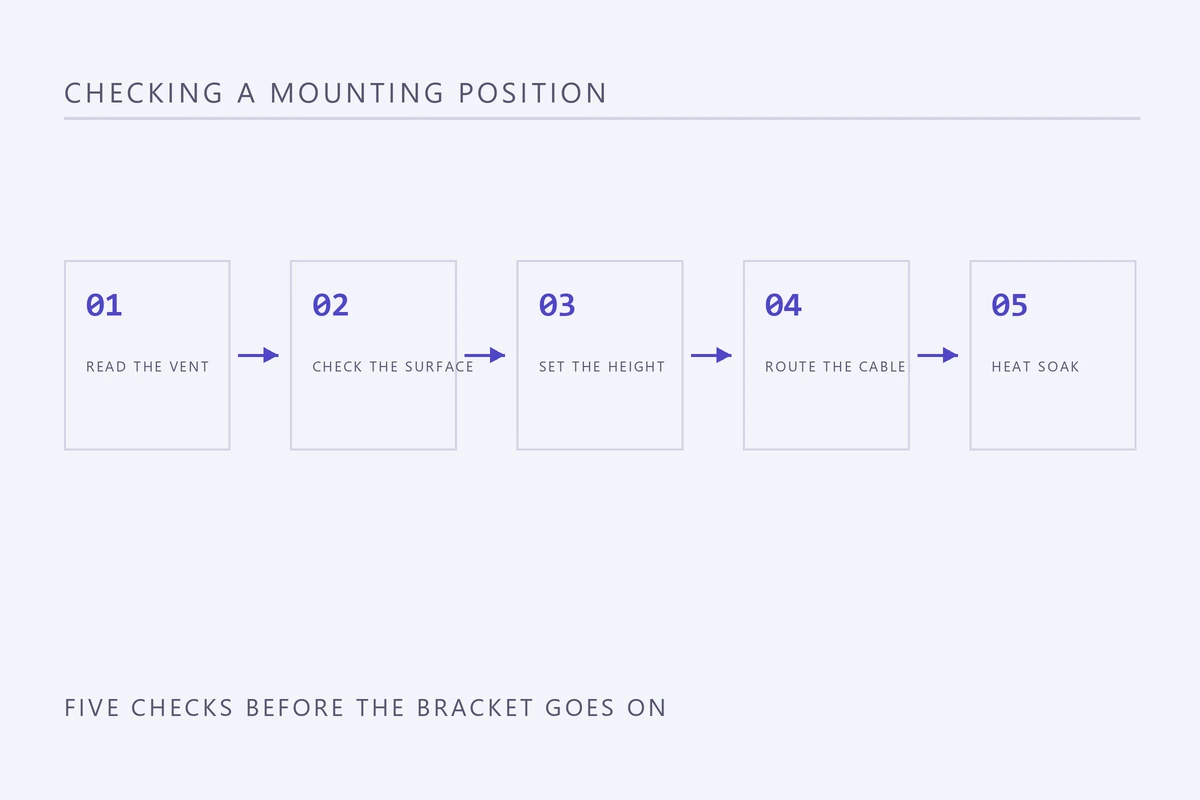
Read the vent, check the surface, set the height, route the cable and heat soak. The order is the useful part: four of the five are cheaper to redo before the bracket is stuck down, and the fifth is the only one that cannot be fixed afterwards.
Buying for a fleet
An installer fitting the same holder to twenty vehicles cares about a different list: one bracket that covers most of the fleet, a fitting kit with the clips that actually fit, and a cable length that suits the shortest and the longest dashboard.
Test on the three most common vehicles in the fleet before the order goes in. A mount that works on a flat dashboard and fails on a curved one is a fitting kit problem rather than a charger problem, and it is solved with a second base rather than with a different coil.
The installation instructions belong in the same order as a spare clip. An installer who has to guess where the base goes will guess differently on the second car, and a fleet with twenty differently angled holders reads as a product that does not fit anything.
The charger is the part that can be certified and measured. The position is the part that decides whether the customer keeps it, and the position is decided in a car park rather than on a specification sheet.
Updated 2026-10-27 · 4 min read. Specifications and profiles change without notice; confirm the current sheet before you publish a retail claim or a tender document.
Questions that come back
Short answers, before the email.
Is a vent or a windscreen mount better?
A vent mount is cooler and sits closer to the wheel. A windscreen mount fits more cars and puts the phone in the sun. The vent wins where the blade is firm, and the glass wins where it is not.
Will a magnetic charger hold a large phone?
The ring holds a large phone if the case is thin and the arm can carry the weight. The arm and the ball joint are what fail first, so ask what the joint is rated to hold.
Does heat stop a car charger working?
It slows it. A phone on a dashboard in direct sun derates, and the charger follows it down. A vent position or a shade keeps the charge rate where the box says it is.
Can a mount stay in the car all year?
An adhesive base on a textured dashboard may not survive a summer. Ask what the adhesive is rated for and check the surface before fitting rather than after the first hot week.
Where should the phone sit?
Below the mirror, above the wheel, outside the area the wipers sweep, and clear of the controls and the airbag covers. That leaves fewer positions than most drivers expect.
Send the phone list, get the configuration.
Build, profile and the certificate list for each line item, in one reply.