RV and yacht wireless charging: 12 V supply, motion and mounting
A camper, a motorhome and a yacht share three conditions that a desk charger never meets: a 12 V house bank instead of a wall socket, a surface that moves, and a cabin that gets hot with the blinds closed. The charging head is the same Qi2 part that sits on a bedside table. Everything around it changes.
Start with the supply, not the charger
A magnetic charger is fed from USB-C, so the question on a vehicle is not the mains, it is the converter between the house bank and the port. A 15 W build wants a source in the 20 W class. A 25 W build wants a supply rated above 25 W, which is the same rule that applies in a house, and a 12 V socket adapter that only offers 5 V will charge the phone slowly and the charger will take the blame.
Two routes work. A socket adapter rated for the charger's input is the quick one and it is what most retrofit jobs use. A hardwired converter behind the panel is the better one: no plug to vibrate loose, a fuse at the battery end, and a cable run sized for the voltage drop. On a 24 V bank the converter has to be rated for the input, and on a small bank the charger's draw belongs in the nightly budget before anything else is added to it.
The mount is the part that fails
A magnet ring holds a phone through a case, and it is rarely the weak point. The base is. A vent clip needs a horizontal blade, which a car has and a boat mostly does not, and a dashboard base needs a flat surface that is still flat at 40 degrees in the sun. Gelcoat, teak and vinyl trim are the three surfaces that catch buyers out, and only one of them takes an adhesive with confidence.
On anything that moves, the phone also wants a lip or a cradle rather than a flat pad. The ring holds the phone to the charger; it does not stop the phone rotating or sliding when the vehicle pitches. The vent mount and its dashboard sibling are the two fittings to compare, and the fitting kit in the box decides whether an installer will use either one.
Heat behind glass
A cab in the sun and a saloon behind a wrap around window are the same problem: the phone gets hot before the charger does. The charger measures its own temperature, reduces power, and the phone reports a slow charge. None of that is a fault and no specification fixes it, so the answer is siting. Shade, a vent in the airflow, or a mount lower on the dash and out of the direct glass line.
A yacht has the opposite failure in the cold. A phone left on a cold flybridge charges slowly and the customer reads it as a weak charger, which is the same derating working the other way. The figure to publish is the charge at the temperature the cabin actually reaches, not the one measured on a bench.
The pack that needs no wiring
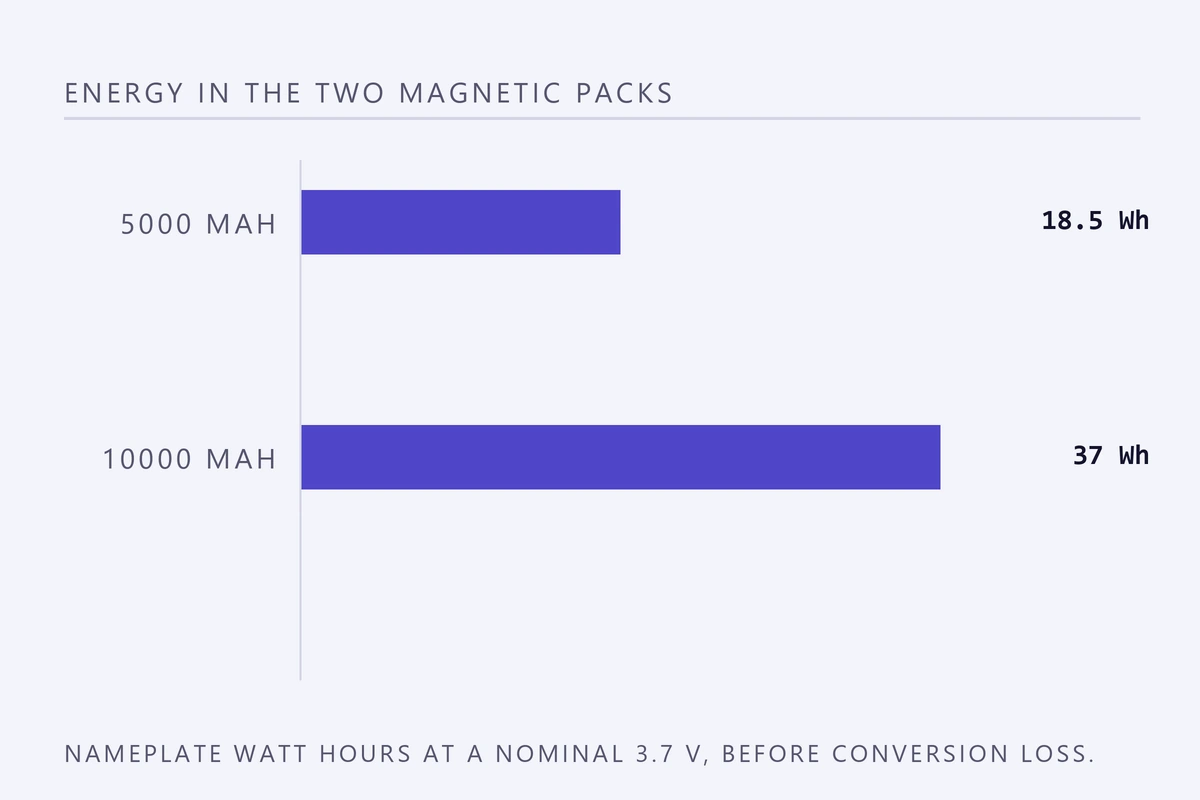
Half of the retrofit jobs on these vehicles never touch the wiring. A magnetic pack on the back of the phone answers the question for a night, and it charges from the same USB-C converter in the morning. The 5000 mAh pack holds 18.5 Wh and the 10000 mAh pack holds 37 Wh, which is roughly one charge and two charges of a current phone before losses.
That is the low risk option on a vehicle nobody wants to drill, and it suits a phone that lives in a pocket most of the day and only needs the charger at anchor or on a pitch. The cost is the second thing to carry, and the case on the phone has to pass the magnet.
A fixed position beats a moving one
Where the vehicle has a permanent place for a phone, a station fixed to a bulkhead or the end of a cabinet is easier to live with than a mount that swings. The 3 in 1 station runs three devices from one USB-C input, which suits a berth or a dinette where a phone, a watch and earbuds all end up on the same shelf, and the cable is routed behind the panel once instead of being plugged in every evening.
The mechanical question is the one a house asks as well: the surface has to be flat and thick enough to take the fixing, and the station has to be reachable from the bunk or the seat that will use it. A station two steps away is a station that gets used at the table and nowhere else.
What to write into the brief
- Supply: bank voltage, the converter's output, and its rating against the charger's input.
- Fixing: the surface, its thickness, and whether an adhesive or a screw is allowed.
- Cable: length, route, and the fuse at the battery end.
- Heat: where the sun lands, and whether the phone can be shaded there.
- Devices: the phone models, and whether a watch and earbuds charge in the same place.
A retrofit is decided by the surface and the cable, not by the wattage. Send a photograph of the mounting point with a measurement across it, and the answer stops being a guess.
Updated 2026-10-25 · 4 min read. Specifications and profiles change without notice; confirm the current sheet before you publish a retail claim or a tender document.
Questions that come back
Short answers, before the email.
Can a Qi2 charger run from a 12 V socket?
Yes, with an adapter that offers USB-C PD at or above the charger's input. An adapter limited to 5 V will charge the phone slowly, and the charger will look worse than it is.
Will the magnet hold on a boat?
The ring holds the phone. The base decides the rest: a flat, solid surface with a proper adhesive or a screw, and a lip or cradle so the phone cannot rotate as the hull moves.
Do I need an inverter?
Not for a USB-C charger or a pack. An inverter is for a device that only takes mains, and then the charger's draw belongs in the nightly budget alongside it.
Does a thick case matter?
It costs more charge than the difference between a 15 W and a 25 W build. Check that the ring holds through the case that will actually be used, not the bare phone.
Which is the safer choice on a small bank?
The 15 W build, or a pack. A 25 W build needs a supply above 25 W and produces more heat in a cabin that is already warm, which is the harder combination to defend.
Send the phone list, get the configuration.
Build, profile and the certificate list for each line item, in one reply.