MagSafe and Qi2: two names, two owners, one magnet ring
The two words get used as if they meant the same thing, and they do not. One is a brand name that belongs to Apple. The other is a charging profile published by the Wireless Power Consortium, and a supplier can certify a product against it. The magnet ring in the middle is a piece of hardware that neither word owns.
Two words, two owners
MagSafe is Apple's name for the magnetic accessory system on the back of its phones, and the name and the logo belong to Apple. Qi2 is a profile inside the Qi standard, published by the WPC, and it describes how a charger and a phone negotiate power across a magnetic interface. A charger built to Qi2 uses a ring of magnets of the same kind, and the standard is what turns that ring into a specification instead of a copy.
That distinction decides what a product may print. A Qi2 entry is a record in a public database, found by model number and checked by anyone. The MagSafe name is not a certificate, and no test house issues it. A brand that puts the word on a box is either authorised to do so or is borrowing something it does not own.
What the ring actually does
Alignment is the whole point. A flat pad asks the user to find the middle; a ring puts the two coils on top of each other every time, which raises coupling and cuts the loss that would have become heat. It also holds the phone at an angle, which is why the same part works on a bedside stand and on a desktop 3 in 1 station.
The ring is not a certification and not a connector. It is two arrays of magnets, one in the phone and one in the charger, plus the shield behind each that keeps the field out of the electronics. Two chargers with identical magnets can still behave differently, because the profile and the power stage decide how much energy crosses the gap.
Three power levels in one range
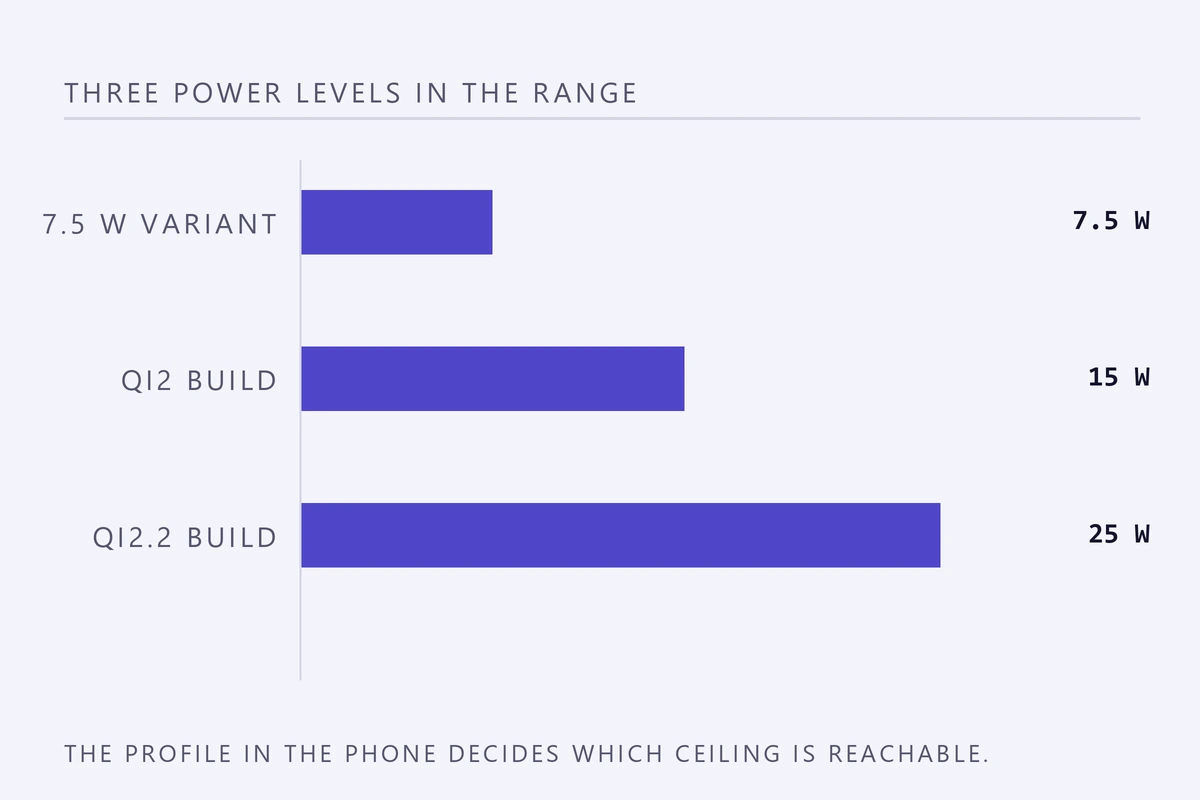
The range this site supplies has a 7.5 W variant, a Qi2 build at 15 W and a Qi2.2 build at 25 W. The ceiling is a property of the pair rather than of the charger alone: a 25 W build only reaches 25 W on a phone that negotiates it, a 15 W build is the ceiling for a Qi2 phone, and a phone without the magnetic profile falls back to a rate the flat standard allows.
That is why the phone list matters more than the number. A claim that names the profile and the phones can be checked by a reviewer with the product in hand. A claim that names wattage alone invites the one star review that says it did not charge quickly.
What the label may say
Compatibility is a sentence, not a badge. "Works with MagSafe" describes a phone the charger can hold and charge, and it is the sort of phrase a marketplace listing can carry without claiming an authorisation. What it must not become is a product name, a logo, or a line that reads as though the accessory were approved by Apple.
- The profile and the ceiling: Qi2 at 15 W or Qi2.2 at 25 W, next to the number rather than in a footnote.
- The phones the figure was measured on: a model list, not a family.
- The adapter: what the input needs for the ceiling to be reachable.
- The magnet ring: described as a part of the product, with the holding force on the drawing.
- The brand word: in a compatibility sentence only, never as the product name.
What to check before the artwork is approved
| Claim | What backs it | What to ask for |
|---|---|---|
| Qi2 at 15 W | A WPC entry per model | The certificate file and the model number on it |
| Qi2.2 at 25 W | A separate entry per model | The phone list the figure came from |
| Works with MagSafe | Compatibility, not an authorisation | The sentence, and the phone family it names |
| MFM | An Apple authorisation in the brand's name | The authorisation itself, before any logo |
| Magnetic | The magnet array in the product | The array drawing and the holding force |
The practical test is the one a buyer can run without asking permission: take the model number from the quotation, look it up, and compare the profile and the ceiling with the artwork. If the artwork carries a word the database does not, the artwork is the problem.
Where the two words still catch people out
Support scripts are the first place. A customer with a Qi2 phone and a charger sold as compatible with the magnetic standard will ask why the charge is not faster, and the honest answer is about the profile and the phone rather than about the brand.
Marketplace listings are the second. A brand word in a title attracts a takedown in some channels and a rejected listing in others, and the same product with the compatibility sentence in the bullets sells without the risk.
Artwork is the third. A logo file supplied with a photorealistic render of a phone is the most common way a brand word arrives on a box that nobody in the brand approved, and the moment to catch it is the first proof, not the first shipment.
A magnet ring is hardware. A profile is a document. A brand name is neither, and the three are the reason two products that look identical can make very different claims on the shelf.
Updated 2026-10-26 · 4 min read. Specifications and profiles change without notice; confirm the current sheet before you publish a retail claim or a tender document.
Questions that come back
Short answers, before the email.
Is Qi2 the same as MagSafe?
No. Qi2 is a charging profile published by the WPC and a product can be certified against it. MagSafe is Apple's name for the magnetic system on its phones and accessories, and the name belongs to Apple.
Does a Qi2 charger work on a phone with a MagSafe ring?
It holds and it charges, at the rate the phone negotiates. The magnet ring is what makes the alignment repeatable, and the profile is what makes the rate predictable.
Can a brand put MagSafe on its box?
Only in a compatibility sentence, unless the brand holds an authorisation that names it. The safe version names the phones the charger works with and keeps Apple's name out of the product name and the logo.
Is an MFM authorisation needed to sell a magnetic charger?
Not for the magnets and not for Qi2. MFM is an Apple programme that covers the use of Apple's marks rather than the physics of a magnet.
Which ceiling should a brand choose?
The one the phone fleet supports. A 15 W build suits a mixed fleet and a 25 W build suits a Qi2.2 launch, and the phone list is the document that decides it.
Send the phone list, get the configuration.
Build, profile and the certificate list for each line item, in one reply.