Magnetic vs clamp car mount: the five checks in order
A magnet and a clamp both hold a phone in a car, and they fail in different places. The magnet fails when the phone has no ring or the case sits too far from the coil. The clamp fails when its jaws cannot reach round a bulky case, or when the vent blade it clips to is the weakest part of the vent. Five checks settle which one a fleet or a brand should buy, and the order is what makes them useful.
Two mechanisms, two failures
A magnetic mount carries a ring of magnets, in the phone or on a plate fixed to the case, and the phone sits flat against the head. A clamp grips the phone at its edges, and the head is a pair of jaws on a ball joint. The difference is not strength. It is what each mechanism needs from the phone before it can hold it at all.
That is why the two are sold to different buyers. A magnetic head can carry a charging coil, because the face of the phone lies against the face of the head. A clamp has to leave the edges free, so the coil sits behind the jaws, and a clamp that charges has to be lined up by hand every time the phone goes in.
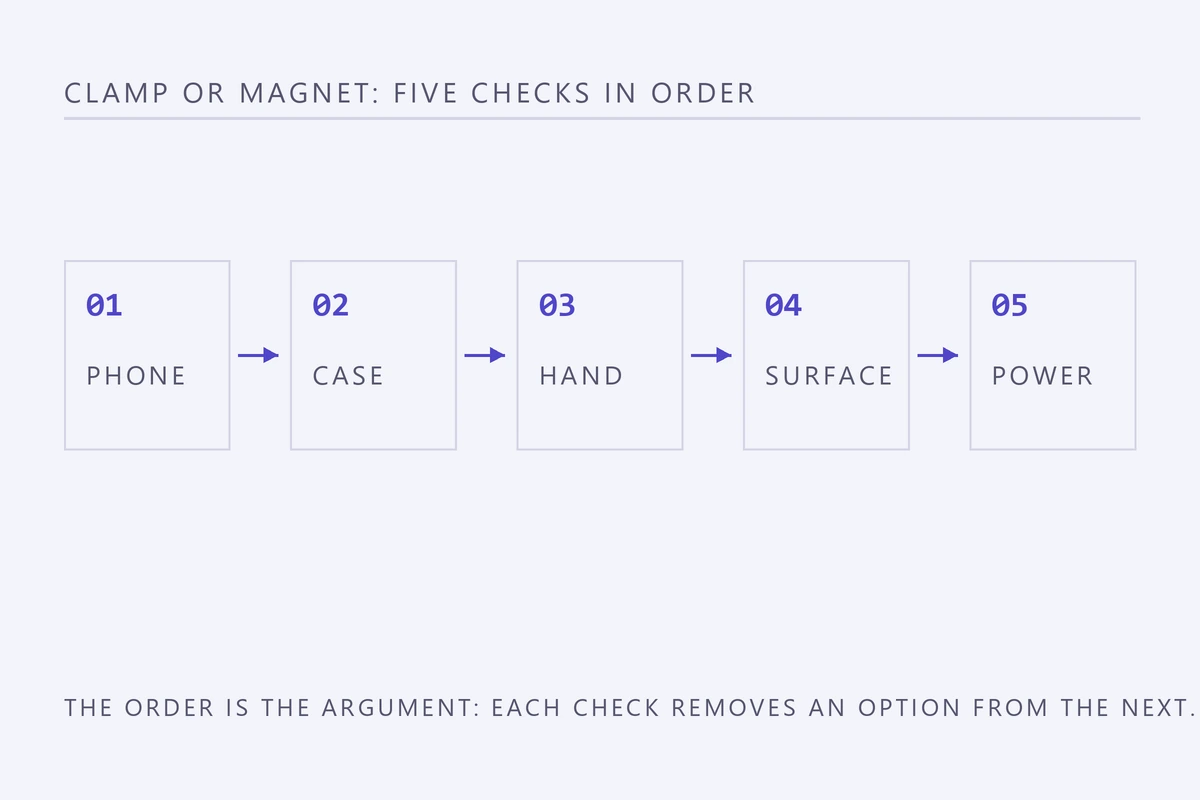
One and two: the phone and the case
The first check is whether the phone has a magnet array of its own. A phone with the ring built in attaches to a magnetic head with nothing added. A phone without one needs a ring or a plate, and a plate is a metal disc that takes the field the charger needs, so a plate and wireless charging do not share a phone.
A clamp does not care. It grips the edges, so any phone fits, which is why clamp mounts still sell into fleets with a mixed phone list. The cost arrives later: a clamp holds a phone without charging it unless the jaws are deep enough to put a coil behind the phone's own coil.
A case is a distance. On a magnetic head every millimetre between the two coils is coupling lost, and a case with a metal plate, a card slot or a folding stand moves the phone away from the face. The ring has a rated gap, and past it the phone still holds while the charge slows and the pair derates.
On a clamp the case is a dimension rather than a distance. A thick case is fine if the jaws open far enough, and the failure is a phone that sits loose or a jaw that marks the edge of the case. Ask for the jaw opening and the case depth that was tested, in the same email.
Three and four: one hand and the surface
The magnet wins this one and it is not close. The phone goes on and comes off with one hand and without looking, which is the whole point of a mount in a car, and it is why a magnetic head is what most drivers want once they have used one.
A clamp usually asks for two hands: one to hold the phone, one to open the jaws. A spring-loaded clamp can be opened with the phone itself, and the spring is then the part that wears. For a hire fleet or a demonstration car, the difference is a return rate rather than a preference.
Both mechanisms end at the same three places: a vent blade, the dashboard or the glass. A magnetic vent mount is small and clips to a horizontal blade, and the blade decides whether it stays. A dashboard mount carries a longer arm on an adhesive or a suction base, and the surface decides whether that stays.
A clamp is heavier, because the jaws and the spring are metal, so it asks more of the same blade. On a car with thin louvres the clamp is the mechanism that breaks the vent, and the repair is a dashboard rather than a mount. Check the blade before the mount.
Five: the power
The last check is whether the mount charges. Both builds in this line carry a 15W Qi2 coil, the vent version behind a small head and the dashboard version on a longer arm, and neither asks the phone for a cable. The coil is why the magnet and the charger are the same part: alignment is most of the efficiency, so a head that holds the phone in the right place is doing half of the electrical work.
A clamp can charge as well, and it has to solve alignment with a stop or a shelf, because nothing in the jaws puts the phone's coil over the charger's coil. That is a mechanical problem with a mechanical answer, and it is why a charging clamp is a bigger product than a clamp.
The five checks, side by side
| Check | Magnetic head | Clamp |
|---|---|---|
| The phone | Needs the ring, or a case that has one | Any phone, no ring needed |
| The case | A rated gap, and a plate stops the charge | A jaw opening, and marks at the edge |
| One hand | On and off without looking | Usually two hands, or a spring that wears |
| The surface | A small head, kinder to a vent blade | Heavier, and the blade takes the load |
| The power | The coil sits behind the face | A coil needs a stop to align it |
Read down the middle column and the magnetic head wins four of the five. Read down the right column and the clamp wins the one that decides a mixed fleet, which is the phone list. A buyer with one phone model and a charger in the brief is buying the magnet. A buyer fitting out cars they do not own, with phones they cannot choose, is buying the clamp or a magnetic head plus a ring in the box.
What to put in the brief
- The phone list, and whether the ring is in the phone, in the case or on a plate.
- The case: depth, and whether it carries a plate, a card or a stand.
- The blade: horizontal or vertical, and how firm the louvre is.
- The surface: glass, a textured dash or a curved panel, because adhesive and suction fail differently.
- The power: a 15W coil wired to the cabin, or a passive head with no cable. The two are different products.
A brief with those five lines comes back as one mount instead of a range. A brief without them comes back as a photograph of a phone on a vent, and the first sample is where the blade gets tested.
The magnet holds the phone. The blade holds the mount. Only one of the two is in the specification.
Updated 2026-10-31 · 5 min read. Specifications and profiles change without notice; confirm the current sheet before you publish a retail claim or a tender document.
Questions that come back
Short answers, before the email.
Can a clamp mount charge a phone wirelessly?
Yes, and it has to align the coil by hand unless the jaws carry a stop. The clamp grips the edges, so nothing in the mechanism puts the phone's coil over the charger's.
Will a magnetic mount hold a phone in a thick case?
It will hold and the charge will slow. Every millimetre of case is coupling lost, and a case with a metal plate blocks the field altogether. Test the case that will actually be used.
Which is better for a rental or demonstration fleet?
A clamp fits any phone without an accessory, which suits a fleet with a mixed and changing phone list. A magnetic head is faster to use and needs the ring in the phone or in the case.
Does a vent clamp damage the vent?
It can. The jaws and the spring put load on louvres that were not designed for it, and a thin blade is the part that breaks. Ask which blade the clip is rated for.
Does a magnetic car mount need power?
Only if it charges. A passive magnetic head is a holder, and a 15W build carries a coil and a cable to the cabin. The mount and the charger are the same part once the head aligns the phone.
Send the phone list, get the configuration.
Build, profile and the certificate list for each line item, in one reply.