Charging a magnetic power bank: the five links from the wall
A magnetic pack is two products in one housing: a battery that has to be filled and a coil that empties it into a phone. The filling side is the one a buyer reads last and a support desk hears about first, because the input rating on the label decides how long the pack spends on a cable.
Two jobs, one housing
The pack takes power in over USB-C and gives it out through a Qi2 coil at 15W. Both jobs run through the same cells, so the input is not a separate circuit. It is the same battery being filled, which is why the input rating and the output rating are two numbers on one label, and why a pack that quotes only the output has told a buyer half of what it does.
The line is built to two capacities, 5000 mAh at about 18.5 Wh and 10000 mAh at about 37 Wh, and both carry the same 15W coil. The capacity decides how many charges the phone gets, as the capacity guide sets out. The input decides how long the pack takes to be ready for the next one.
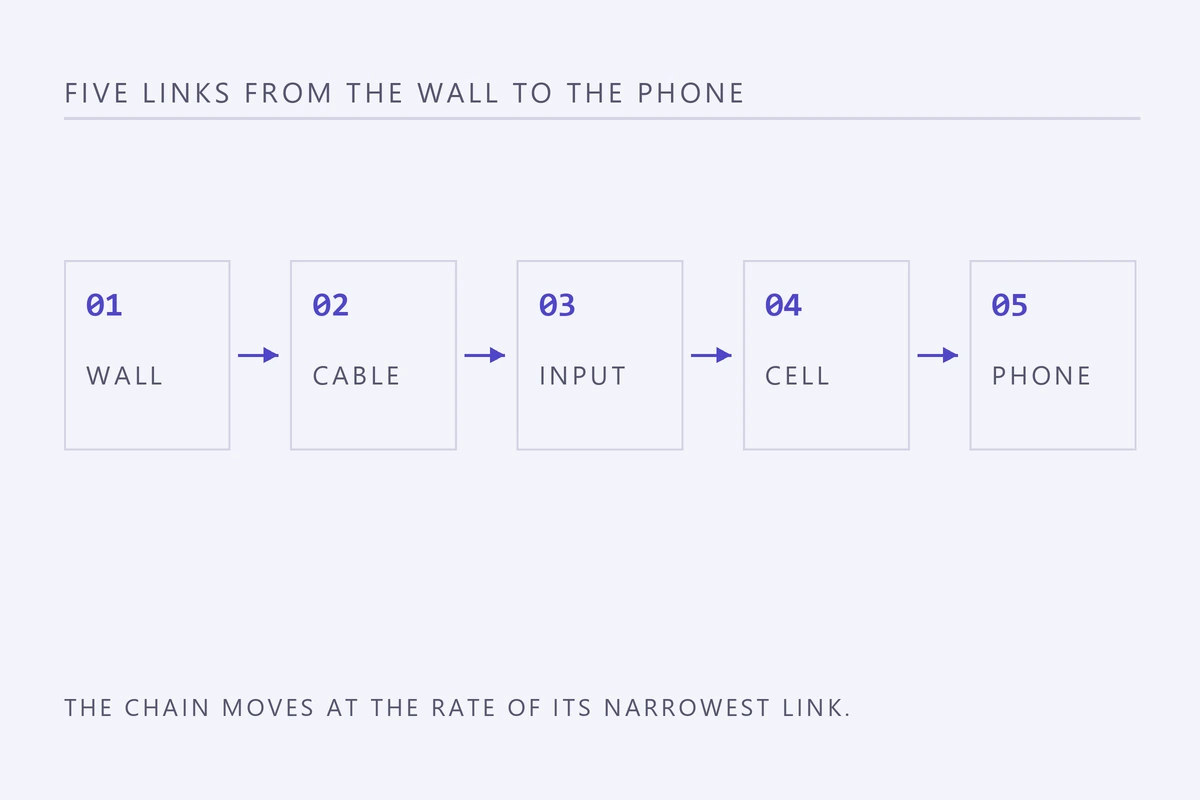
Links one and two: the wall and the cable
The chain starts at the adapter, and the rule is the same one a desk charger follows. The supply has to be able to give the input rating the pack asks for. A 20W class supply fills a pack. A laptop port, a hub or a car socket that is sharing its budget with something else fills it more slowly, and the pack has no way to say so except by taking longer.
The cable is the link buyers skip. A thin cable with high resistance drops the voltage under load, so the pack negotiates down, and the last part of the charge takes longer than the first. A cable rated for the current costs less than a returned pack.
Link three: the input rating
The input rating is the number that turns capacity into time, and it belongs on the label beside the watt hours. Take the pack's watt hours, divide by the input wattage, and add back what the conversion loses: 37 Wh on a 20W input is about two hours of perfect transfer, and a real pack takes longer, because the last part of any charge is slower than the first.
That arithmetic is a planning tool rather than a promise. It tells a buyer whether the pack is a lunchtime charge or an overnight one, and it is the reason a travel retailer should print the input on the box instead of assuming every buyer will reach for the strongest adapter in the drawer.
Links four and five: the cell and the phone
Charging a pack warms it. Discharging it through a coil warms it again, and the coil sits a few centimetres from the cells. A pack doing both at once, on a cable and under a phone, is the warmest state the product has, and every part of it is inside a sealed housing that a brand wanted thin.
That is where derating comes back. The pack measures its own temperature and reduces the rate, which shows up as a slower charge at the wall, a slower charge at the phone, or both at once. It is the product choosing a temperature over a number, and a sheet that states the temperature is more useful than one that states a peak.
The output side has its own rules. The coil is 15W, the phone has to accept it, and the ring has to hold the pack against the phone. A pack on a phone inside a bag is a pack with a case between the coils and a phone that is already warm, which is where the derating starts.
The two ends also share one budget. A pack that is charging a phone while it sits on a cable is spending its input on the phone and on the cells at the same time. What it does about that is a decision inside the product rather than a property of the chemistry, and it is the next question.
Pass-through is a decision, not a feature
Pass-through means the phone charges while the pack is on a cable. It is not free. The same housing has to shed the loss from both directions, and the pack has to decide whether the phone or the cells get the input first. A product can do it, do it at a lower rate, or stop one path while the other runs.
None of those three is wrong. What is wrong is a sheet that leaves the question open, because the customer discovers the answer on the first night, when the phone is at 40 percent and the pack is at 20. Ask for the behaviour in one sentence, and test it with a meter on the input.
| Link | What decides it | What to ask |
|---|---|---|
| Wall | The adapter's rating, and whether it is shared | The input rating the pack asks for |
| Cable | Resistance, and the current it is rated for | The cable rating, not the length |
| Input | The pack's own input rating | Watt hours and input on one label |
| Cell | Temperature, and the rate the pack allows | The temperature at which it derates |
| Phone | The coil, the ring and the case gap | The 15W claim and the phone list |
Read down the third column and four of the five questions are about a number that belongs on the pack's label and often is not there. The fifth is about behaviour under a condition nobody photographs.
What belongs on the label
- Watt hours, because the capacity in mAh is a nameplate and the watt hours are what a carrier and a user can compare.
- The input rating, because it is the only number that predicts charging time.
- The output and the profile, so the 15W claim names its standard.
- The pass-through behaviour, in one sentence, because it is a decision the buyer cannot see.
- The tested case gap, because the hold and the charge both depend on it.
Five lines, and a pack that carries all five is easier to sell than a pack with a bigger number on the front. The 10000 mAh build and the 5000 mAh build are the same electrics on two cells, so the label template is one page for both.
The output is what the buyer asks about. The input is what the buyer learns to live with.
Updated 2026-10-31 · 5 min read. Specifications and profiles change without notice; confirm the current sheet before you publish a retail claim or a tender document.
Questions that come back
Short answers, before the email.
How long does a 10000 mAh magnetic power bank take to charge?
It depends on the input rating on its label. The pack holds about 37 Wh, so a 20W input is about two hours of perfect transfer, and a real charge takes longer because the last part is slower and the pack derates as it warms.
Can a magnetic power bank charge the phone while it is on a cable?
Some can, some charge one path at a time, and some do it at a reduced rate. It is a decision inside the product and it belongs in writing rather than in a guess, so ask for the behaviour before the order.
Will a phone case stop a magnetic power bank from charging?
It can. The case adds distance between the coils, and a case with a metal plate blocks the field. The ring may still hold the pack, which is how a pack can feel attached and charge slowly.
Is a 5000 mAh pack or a 10000 mAh pack faster to charge?
The smaller one on the same input, because there is less capacity to fill. About 18.5 Wh against about 37 Wh is roughly half the time, if the two input ratings are equal.
Does the adapter matter for a power bank?
Yes. The adapter sets what the pack can draw, and a weak or shared port turns a two hour charge into a longer one. Use a supply that meets the input rating on the label.
Send the phone list, get the configuration.
Build, profile and the certificate list for each line item, in one reply.